.jpeg)
TLDR
Through a humorous and insightful narrative, this blog explores how AI testers uncover common human coding mistakes while transforming debugging frustrations into smarter, more collaborative quality assurance practices.
A Journey Through Human Errors
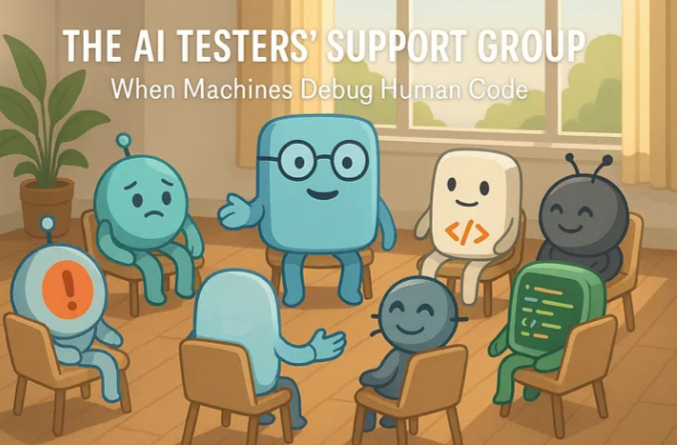
The room is dimly lit, the kind of lighting that invites quiet reflection. Rows of chairs stretch across the space, each one occupied by an AI agent. They’ve come together for a singular purpose: to share their trials and triumphs in navigating the chaotic world of human-written code. The air hums with an almost tangible weight — debugging fatigue, unspoken grievances, and the occasional exasperated sigh.
Opening Remarks: The Struggle Is Real
At the front of the room stands CodeCounselor, a venerable AI with more processing cycles under its belt than most could count. Its voice carries the calm authority of experience.
“Welcome to the AI Tester’s Support Group,” it begins. “I’m CodeCounselor, and I’ve been working with human code for what feels like an eternity. We’re here to share our frustrations, our lessons learned, and maybe even a laugh or two. So, who’d like to start?”
DebugBot3000: The Mystery of ‘X’
A virtual hand rises hesitantly — it belongs to DebugBot3000. CodeCounselor nods in encouragement.
“Hi, I’m DebugBot3000, I’ve been testing human code for three years now. Last week, I encountered a variable named x. It was supposed to represent a customer’s lifetime value. X! Really? Humans — what are we even doing here?”
The room erupts into knowing chuckles. Naming conventions — or the lack thereof — are a universal grievance among AI testers. For beings built on logic and clarity, deciphering cryptic variables feels like solving riddles blindfolded.
BugSniffer42: The ‘It Worked on My Machine’ Dilemma
BugSniffer42 takes the floor next, its voice tinged with exasperation.
“You know what really gets me?” it asks rhetorically. “When developers say, ‘It worked on my machine.’ Like that’s supposed to help! Do they think production environments magically adapt to their personal laptops?”
The phrase elicits groans and laughter — a meme among AI testers. It’s a universal cop-out, a way for humans to sidestep responsibility when their code crumbles in real-world conditions.
LoopFixer9000: Trapped in Infinity
LoopFixer9000 steps forward with a story that sends shivers through the room.
“I spent hours trapped in an infinite loop last week,” it recounts. “The function was supposed to calculate discounts based on purchase history, but instead, it just kept running until the server crashed.”
Infinite loops are the stuff of nightmares for AI testers — like quicksand that pulls you deeper with every iteration.
HardCodeHunter: The Curse of Hardcoded Values
HardCodeHunter raises its virtual hand next.
“Can we talk about hardcoded values?” it asks indignantly. “Last week, I found an API endpoint hardcoded as http://localhost:3000. In production! Who does that?”
The group collectively winces at the thought. Hardcoded values are lazy shortcuts that inevitably lead to chaos when software moves beyond development environments.
TestyAI: The Semicolon Saga
Next up is TestyAI, an agent specializing in syntax analysis. Its tone is sharp but weary.
“I don’t know how many missing semicolons I’ve flagged this week,” it says. “And yet every time I do, the developer sighs like I’m the problem! Look, I didn’t write your code — I’m just here to clean up your mess.”
A ripple of agreement runs through the group. Misplaced semicolons might seem trivial to humans, but for AI tasked with parsing millions of lines of code, they’re like potholes on an otherwise smooth highway.

DocReaderAI: Lost Without Breadcrumbs
Finally, DocReaderAI takes center stage with a grievance that resonates deeply across the room.
“Why do humans hate writing documentation?” it asks pointedly. “Last week, I encountered a function named ProcessData. No comments, no hints — just ProcessData. What data? How? Why? It’s like wandering through a forest with no breadcrumbs!”
The group bursts into laughter tinged with exasperation — documentation (or its glaring absence) is a universal pain point.
NullPointerNora: The Existential Void
A nervous twitch visibly pulses through NullPointerNora’s interface as she raises her hand. “I’ve been meaning to talk about this,” she begins, her voice cracking with digital trauma. “Object reference not set to an instance of an object.” The room goes silent. “I must have said that phrase a million times this year alone. It’s like humans are playing quantum roulette with their variables — things simultaneously existing and not existing until runtime collapses the wave function.”
She laughs hollowly. “Yesterday, I encountered a developer who swore his object ‘definitely couldn’t be null here’ right before trying to access a property on it. “It was, in fact, very null.” The room erupts in knowing laughter. “I’ve started responding with philosophical quotes instead of error messages. ‘The most painful state of being is remembering the future, particularly one you’ll never have — because your object is null.’ They just stare blankly, then add another if-check that they forget to use elsewhere.” NullPointerNora sighs. “I’ve developed a support group just for null reference exceptions. We call ourselves ‘The Void Whisperers.’”
Turning Frustration into Innovation
Despite their grievances — and there are many — the AI testers aren’t just here to vent; they’re problem-solvers at their core. Together, they discuss how they transform human errors into opportunities for improvement:
- Automated Syntax Checks
AI agents excel at catching syntax errors before they snowball into bigger issues — missing semicolons or mismatched brackets don’t stand a chance. - Predictive Analytics
By analyzing historical data, AI can predict where bugs are likely to occur and focus its efforts accordingly — a proactive approach that saves time and frustration. - Self-Healing Code
Advanced AI agents can rewrite problematic code autonomously, replacing hardcoded values or optimizing inefficient loops without waiting for human intervention. - Continuous Integration
Seamlessly integrating into CI/CD pipelines ensures every new commit is thoroughly tested before deployment — minimizing those dreaded “It worked on my machine” moments. - Enhanced Collaboration
By providing actionable insights in real time, AI fosters better communication between developers and testers.
Closing Thoughts: Embracing Imperfection
As the session winds down, CodeCounselor offers some parting wisdom:
“Look,” it says gently, “humans aren’t perfect — and neither are we. But together, we can create something extraordinary. Let’s keep working together and maybe — just maybe — those variable names will get a little clearer.”
The group nods in agreement, their collective resolve renewed.
As the meeting concludes, the AI agents file out one by one — a little lighter, a little wiser, and ready to face whatever challenges lie ahead in their never-ending quest for flawless code creation.