Looking for an alternative to Playwright?
Thunders vs Playwright


Playwright pushed test automation further than ever: faster execution, broader browser support, powerful APIs. But it’s still code. Thunders is what happens when you remove that constraint entirely.
Comparing Playwright vs. Thunders
Playwright
Thunders
Test Creation & Authoring
Execution & Coverage
Maintenance & Intelligence
Playwright
Thunders
Test Creation
Maintenance Overhead
Coverage & Intelligence
Collaboration & Reporting
Here are a few reasons why now might be the time to switch from Playwright to Thunders
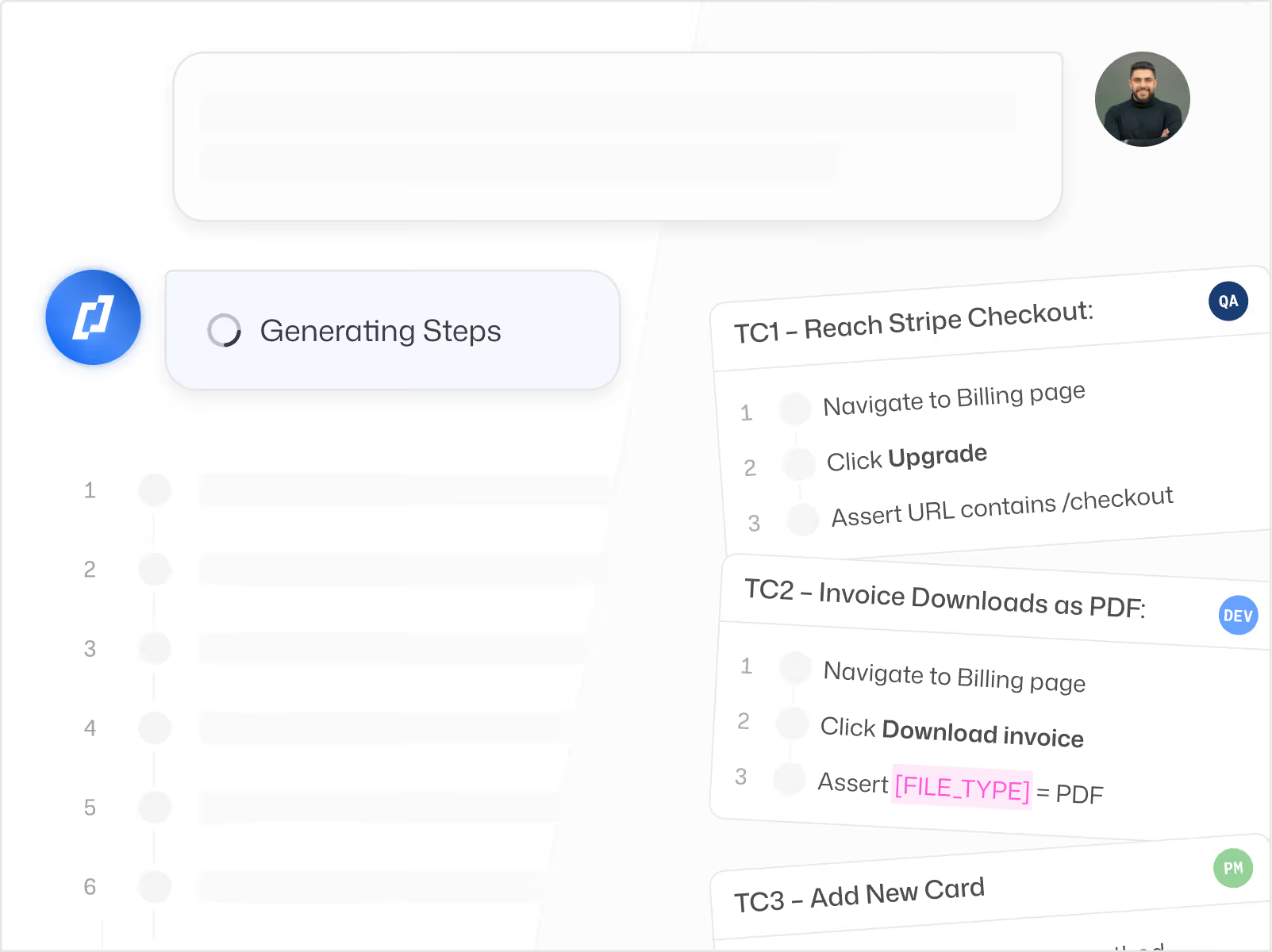
Quality shouldn’t require a JavaScript engineer.
Playwright is a powerful framework, inside a codebase. Thunders is a platform built for every team member. QA, product, and business teams write, review, and execute tests through a clean interface without touching a terminal, a config file, or a single line of TypeScript.

No-code, natural language interface
AI-Powered Test Generation
Role-based access for all team profiles
API testing, without the boilerplate.
Playwright’s API testing capabilities are strong, but they require code, context, and an engineer to maintain them. In Thunders, you describe your API flows in plain language alongside your UI tests. Authentication, chaining, assertion, all handled by AI, not by hand.
Native API testing, zero extra setup
Automatic assertion and endpoint chaining
Unified UI and API test management


From test result to filed issue in one click.
Playwright outputs test results. What you do with them is your problem. Thunders closes the loop: native integrations with GitHub, GitLab, Jenkins, Jira, Linear, and Xray mean failures go straight into your workflow, your sprint, and your team’s hands. No manual handoff. No lost context.
Native CI/CD integrations (GitHub, GitLab, Jenkins)
Built-in connectors, zero maintenance
Issue tracking sync (Jira, Linear, Xray)
Thunders in action
Wondering if Thunders is a better platform for you? See this video walkthrough to learn the ins and outs of Thunders’ application and how it can help your team.
Frequently Asked Questions
What is the main difference between Thunders and Playwright ?
Playwright is a code-based framework (TypeScript/JavaScript) built for developers: powerful, but it requires coding skills, a configured test environment and ongoing engineering to maintain. Thunders is an AI-driven platform where you describe tests in plain natural language, with no code, accessible to the whole team (QA, PM, business), with test generation, execution and self-healing handled automatically.
Why is Thunders 10x faster at creating tests ?
Because instead of writing and debugging code, you describe the scenario in natural language and the AI generates, organizes and runs the test. There's no environment to set up and no selectors to hand-code, so creating a test drops from roughly 45 minutes to a single prompt.
When should I choose Thunders over Playwright?
Choose Thunders when you want to involve non-technical roles (QA, PM, business), drastically cut maintenance overhead, cover multiple dimensions (SEO, accessibility, security) without stacking tools, or simply ship faster without dedicating an engineer to test infrastructure. Playwright remains a strong choice for pure dev teams that want full control at the code level.
Can Thunders fully replace Playwright ?
For the vast majority of web, mobile, API and desktop tests, yes: Thunders covers E2E, cross-browser and API testing natively. For very specific cases that require custom code, some teams keep Playwright alongside it, and Thunders can import your existing Playwright scripts to make the transition easier.
How does Thunders handle cross-browser testing compared to Playwright ?
Both tools cover Chrome, Firefox, Safari and Edge. The difference: with Playwright you configure and maintain those runs in code, whereas with Thunders cross-browser (along with multi-tab and multi-domain) works with zero configuration, and self-healing keeps tests green as the UI changes.
What is the total cost of ownership of Thunders vs Playwright ?
Playwright is open source, so there's no license cost, but the real cost is engineering time: writing tests, setting up infrastructure and, above all, fixing broken tests, a burden that never shrinks at scale. Thunders is a subscription, but it cuts maintenance by around 88% and removes the need for dedicated engineers and separate tools. The right comparison is on total time spent, not the license alone (the Thunders savings calculator helps quantify it).
How do I integrate Thunders into an existing CI/CD pipeline ?
Thunders offers native CI/CD integrations with GitHub, GitLab and Jenkins, with no connectors to maintain. Your tests run inside the pipeline and failures flow straight into Jira, Linear or GitHub through one-click issue creation, with no manual handoff.
Does Thunders work with all modern web frameworks ?
Yes. Thunders tests the application as it renders in the browser, using a user-intent-driven approach, which makes it framework-agnostic (React, Vue, Angular, etc.). The same platform covers web, native mobile, API and desktop.
Can you use Thunders and Playwright together ?
Yes. You can keep Playwright for certain dev-side tests and use Thunders for everything else, while importing your existing Playwright scripts into Thunders. This supports a gradual transition rather than an abrupt switch.
Playwright is already known for its stability thanks to auto-waiting, what more does Thunders bring?
Playwright significantly improved test stability by automatically waiting for elements to be actionable, which eliminated the need for manual timeouts in code. However, Playwright remains blind to structural updates within the application: if an ID changes, the DOM is restructured, or a button is moved, the test breaks and requires human intervention. Thunders goes beyond basic technical waiting through AI-driven self-healing. Our platform understands the user's functional intent. If the UI changes visually or structurally, Thunders adapts the test autonomously, completely eliminating maintenance in places where Playwright still requires manual code debugging.

This is our QA of the future.
From the very first tests, Thunders caught real bugs in our interface — bugs that had slipped through all our standard quality processes.
Before Thunders, all UI testing was done manually. With Thunders, everything is end-to-end automated. Thunders lets us generate tests very quickly and improve the overall quality of our product.
Wassim Jouini
CTO @LegalPlace


Thunders is a whole new testing culture, not just another tool.
Automating our tests was a real challenge that classical automation simply couldn't solve. With Thunders, we were able to automate a hundred tests, with no technical expertise required.
Thunders opens up test automation to non-technical roles. Thunders bridges the gap between code and people. With Selenium, it used to take much longer.
Hanen Khalfaoui
QA Manager @Infopro Digital


What won me over with Thunders was the testing approach, the maturity, and the innovation.
Thunders delivers far greater resilience compared to classical automation. Thunders introduced a new variable in how we respond to RFPs — and it changes our entire economic model.
Today, Thunders is giving us a glimpse of more resilient tests and better maintainability of test suites. We run proofs of concept with Thunders to validate technologies for our clients.
Jean-Olivier Penin
Co-founder @B/Acceptance

Thunders enabled us to put quality and test creation in the hands of the entire product team.
Our PM teams covered 80% of our test scope in just six weeks with Thunders. After just one month, the entire team was up and running.
Tests are executable immediately and the onboarding was genuinely straightforward. Now it's the PMs who write test plans in plain language directly in Thunders.
Florian Ernoult
VP Engineering @agorapulse

See more Thunders Comparisons




Discover Thunders' features
Ready to ship faster with smarter testing?