Looking for an alternative to manual testing?
Thunders vs Manual Testing
Manual testing built quality culture. But it was never meant to keep up with teams shipping daily. Here’s what changes when AI handles the execution — and your team focuses on what humans do best.
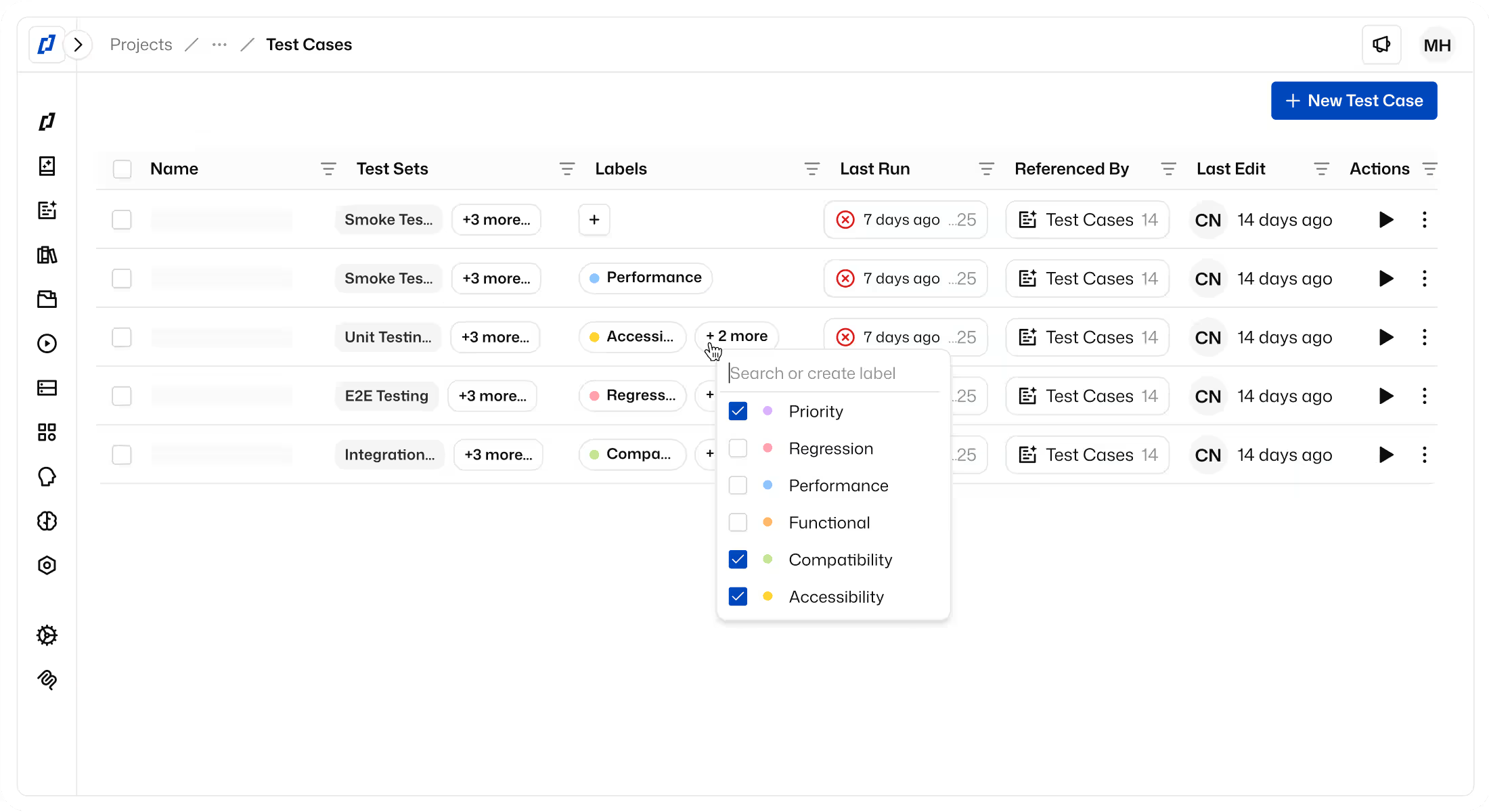
Comparing Manual Testing vs. Thunders

Manual Testing
Thunders
Speed & Scalability
Coverage & Intelligence
Collaboration & Reporting
Manual Testing
Thunders
Speed & Release Velocity
Consistency & Reliability
Coverage & Edge Cases
Reporting & Traceability
Here are a few reasons why now might be the time to move beyond manual testing with Thunders
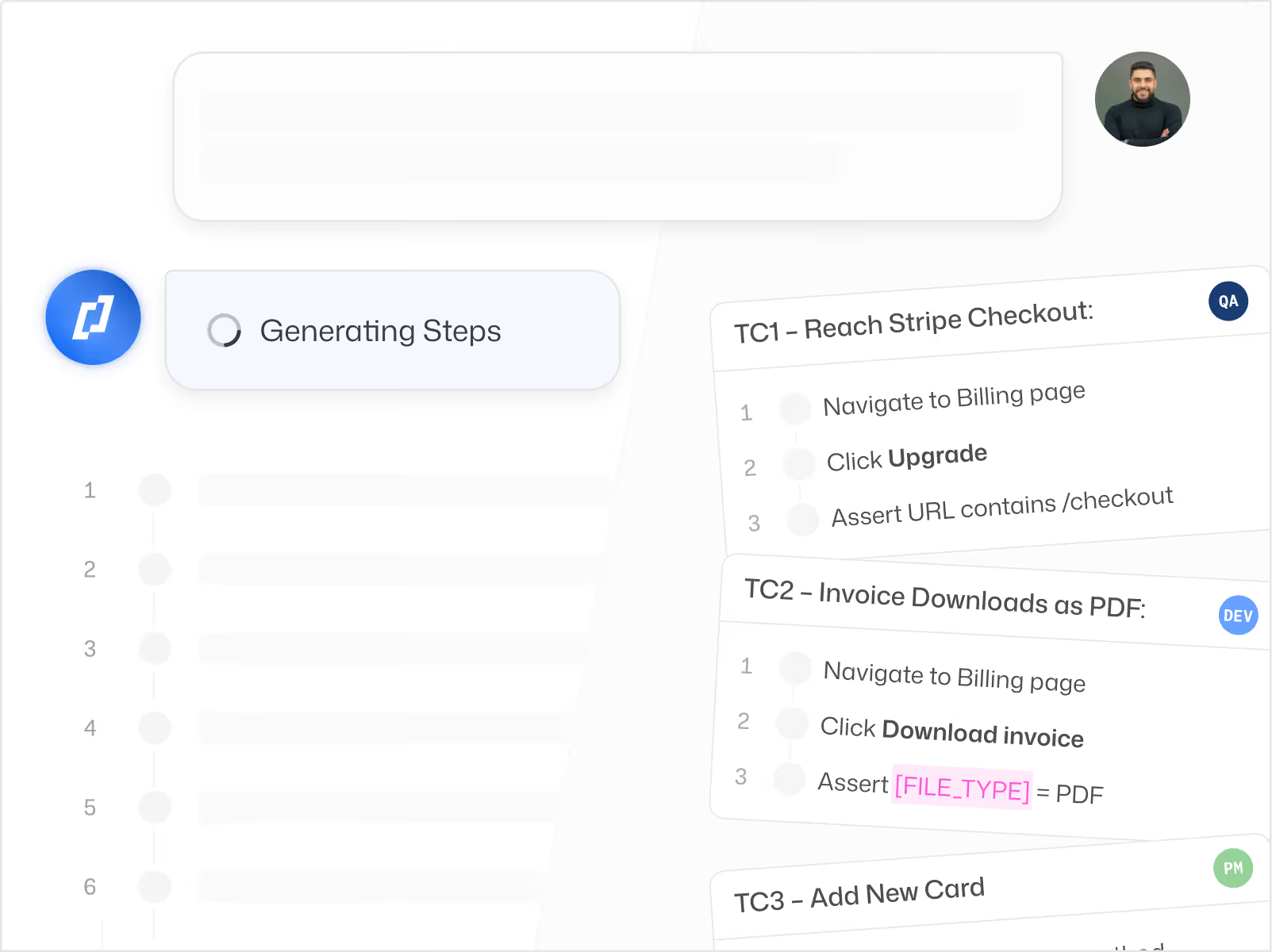
Your team already knows how to use it.
The hardest part of adopting new testing tools is usually the learning curve. Thunders has none. If your team can describe a user flow in a sentence, they can write a test. QA engineers, product managers, and business analysts are productive from day one. No training sprints, no certification required.

No-code, natural language interface
AI-Powered Test Generation
Role-based access for all team profiles
Test what your users can’t see, automatically.
Manual testers validate what appears on screen. API layers, background jobs, and data integrity checks rarely make it into a manual test plan: they require technical knowledge most QA teams don’t have time to develop. Thunders tests your full product surface in plain language: UI flows and API calls, managed from one place.
Native API testing, zero extra setup
Automatic assertion and endpoint chaining
Unified UI and API test management


Test results that go straight to your workflow.
Manual test outcomes require someone to translate them into tickets, update spreadsheets, and notify the right people. In Thunders, failures become filed issues automatically (in Jira, Linear, or GitHub) with full context attached. Your CI/CD pipeline triggers tests. Your team receives results. No manual handoff in between.
Native CI/CD integrations (GitHub, GitLab, Jenkins)
Built-in connectors, zero maintenance
Issue tracking sync (Jira, Linear, Xray)
Thunders in action
Wondering if Thunders is a better platform for you? See this video walkthrough to learn the ins and outs of Thunders’ application and how it can help your team.
Frequently Asked Questions
What are the real limitations of manual testing in 2026 ?
Manual testing has several structural limitations: it is slow (a manual regression suite for a medium-sized SaaS product can take several days per version), inconsistent (fatigue, distraction, and documentation gaps lead to execution variances), and limited in coverage to documented scenarios. Edge cases such as a user opening three tabs, submitting a form twice, or changing languages mid-payment, rarely make it into a manual test plan. Finally, results are scattered across spreadsheets, Confluence pages, and Slack threads, which complicates traceability and auditing. In an environment where teams deliver daily, manual testing can no longer keep pace.
How does Thunders differentiate itself from Selenium, Cypress, and Playwright ?
Thunders.ai differentiates itself across three main axes: accessibility (test creation in natural language without code, whereas Selenium, Cypress, and Playwright require Java, JavaScript, or TypeScript), intelligence (native self-healing, AI Personas for SEO, accessibility, and security, and test generation from specs or Figma), and unification (E2E, API, mobile, and accessibility testing within a single platform with native CI/CD integrations). While open-source frameworks are technical tools meant for developers, Thunders is a platform designed for the entire team (QA, PM, Business). This approach eliminates technical dependency, manual selector maintenance, and tool fragmentation.
What is the true maintenance cost of traditional automated testing ?
The maintenance cost of traditional automated testing is often underestimated: every interface change (class name, data attribute, reorganized DOM) breaks selectors and forces engineers to manually diagnose, update, and fix scripts. As the product evolves, this maintenance can become a full-time job for top developers, who spend a significant portion of their time fixing brittle tests that detect no actual bugs. Added to this are the costs of technical plumbing: reporting plugins, CI/CD integrations, infrastructure management (grids), and complementary tools for API, mobile, or accessibility testing. The total cost of ownership often far exceeds the price of a dedicated tool license.
How do AI and self-healing reduce test maintenance ?
Self-healing relies on a fundamentally different approach than traditional tools: instead of focusing on technical selectors (CSS, XPath), Thunders.ai understands the intent of the test meaning what the user is trying to validate. When the UI changes, the tests automatically adapt to the new structure without human intervention. AI-driven Root Cause Analysis (RCA) also distinguishes true regressions from harmless interface changes, eliminating false positives and useless debugging. This logic cuts out the endless cycle of broken locators and frees teams to focus on quality rather than test infrastructure upkeep.
Why doesn't manual testing scale with DevOps velocity ?
Manual testing does not scale linearly: the more the product grows, the larger the test plan becomes, and the further QA teams fall behind the delivery cadence. They are forced to prioritize what gets tested and what gets ignored, creating a quality risk with every release. Added to this is the human limit: executing the exact same 47-step checkout flow with the same precision for the twelfth time in a week is impossible, as fatigue and repetition inevitably introduce variances. In a DevOps setup where code is delivered multiple times a day, manual testing becomes a structural bottleneck. Thunders.ai runs an entire regression suite in a few minutes, on every build, in parallel across all environments.
When should you still use manual vs. automated testing ?
Manual testing retains its value in several contexts: exploratory testing (freely discovering unexpected behavior), usability testing (subjectively evaluating user experience), validating highly contextual scenarios that are hard to automate, and design phases where the product changes too quickly to justify automation. Humans remain exceptional due to their judgment, creativity, and ability to spot problems no one anticipated. Conversely, the repetitive execution of documented scenarios (regression, non-regression, cross-browser validation) is best handled by an AI like Thunders.ai. The optimal strategy combines both approaches: automate what is repeatable, and keep humans focused on what requires judgment.
What ROI can be expected by switching to Thunders ?
ROI is driven by several factors: massive acceleration of test cycles (a regression suite that used to take several days runs in just a few minutes), elimination of costs tied to ignored flows or undetected regressions, democratization of testing (QA, PM, and Business teams become autonomous), and freeing up QA teams for higher-value tasks (exploratory testing, quality strategy). Added to this is the expanded coverage provided by AI Personas (security, accessibility, SEO) that detect edge cases invisible to manual tests. User feedback published on the Thunders site highlights a 50% reduction in regression test times thanks to parallel execution. ROI is realized across the entire cycle, factoring in delivered quality, release speed, and team satisfaction.
How do you integrate Thunders into an existing QA strategy ?
Integrating Thunders.ai into an existing QA strategy can be done progressively, without sudden disruption. The learning curve is minimal: if the team can describe a user flow in one sentence, they can create a test, and QA, Product, and Business profiles are productive from day one. The recommended approach is to start with a pilot scope (critical paths, main regression suite), then gradually expand to other test types (API, accessibility, security via AI Personas). Thunders integrates natively with existing tools, whether it is Jira, Linear, and Xray for tickets, or GitHub, GitLab, and Jenkins for CI/CD, avoiding any technical plumbing effort. Manual exploratory testing keeps its place for phases where the human touch remains irreplaceable.
How does Thunders.ai guarantee data security and privacy when using AI ?
Security is at the core of the Thunders.ai architecture. Unlike consumer AI tools, our AI is built for the enterprise: your test data, staging databases, and source code are strictly isolated and never used to train public models. Additionally, the platform features native data-masking capabilities to anonymize sensitive information (such as PII or billing data) during test execution on your interfaces. Thunders.ai complies with the strictest security standards (GDPR, SOC 2) to ensure that intelligent automation never comes at the expense of your information system's security.
Does Thunders.ai replace human QA testers ?
Absolutely not. Thunders.ai doesn't replace humans; it frees them from repetitive, mind-numbing tasks. In a traditional setup, a QA engineer spends 80% of their time writing scripts, maintaining broken selectors, and manually executing the exact same regression paths. Thunders.ai takes care of this technical plumbing. Your QA experts can then refocus on high-value missions: test strategy, defining complex business scenarios, risk analysis, and exploratory testing. Thunders.ai transforms your QA team from an execution cost center into a true driver of product strategy.

This is our QA of the future.
From the very first tests, Thunders caught real bugs in our interface — bugs that had slipped through all our standard quality processes.
Before Thunders, all UI testing was done manually. With Thunders, everything is end-to-end automated. Thunders lets us generate tests very quickly and improve the overall quality of our product.
Wassim Jouini
CTO @LegalPlace


Thunders is a whole new testing culture, not just another tool.
Automating our tests was a real challenge that classical automation simply couldn't solve. With Thunders, we were able to automate a hundred tests, with no technical expertise required.
Thunders opens up test automation to non-technical roles. Thunders bridges the gap between code and people. With Selenium, it used to take much longer.
Hanen Khalfaoui
QA Manager @Infopro Digital


What won me over with Thunders was the testing approach, the maturity, and the innovation.
Thunders delivers far greater resilience compared to classical automation. Thunders introduced a new variable in how we respond to RFPs — and it changes our entire economic model.
Today, Thunders is giving us a glimpse of more resilient tests and better maintainability of test suites. We run proofs of concept with Thunders to validate technologies for our clients.
Jean-Olivier Penin
Co-founder @B/Acceptance


Thunders enabled us to put quality and test creation in the hands of the entire product team.
Our PM teams covered 80% of our test scope in just six weeks with Thunders. After just one month, the entire team was up and running.
Tests are executable immediately and the onboarding was genuinely straightforward. Now it's the PMs who write test plans in plain language directly in Thunders.
Florian Ernoult
VP Engineering @agorapulse

See more Thunders Comparisons





Discover Thunders' features
Ready to ship faster with smarter testing?