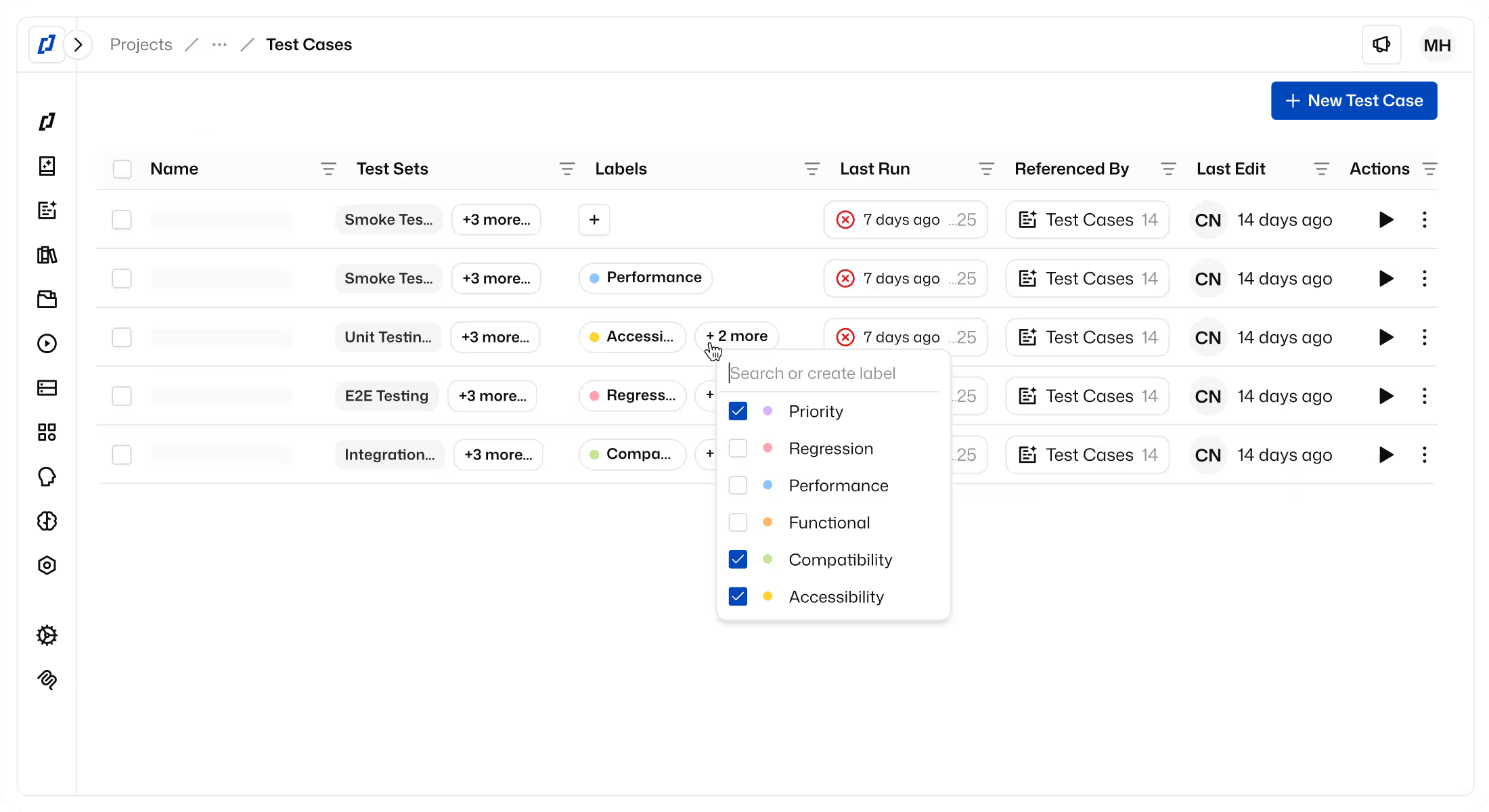
Looking for an alternative to Selenium?
Thunders vs Selenium


Selenium built the foundation of test automation. Thunders builds what comes next. See why modern engineering teams are making the switch.
Comparing Thunders vs Selenium
Selenium
Thunders
Test Creation & Authoring
Execution & Maintenance
Selenium
Thunders
Test Creation
Test Maintenance
Coverage & Intelligence
Reporting & Integration
Here are a few reasons why now might be the time to switch from Selenium to Thunders
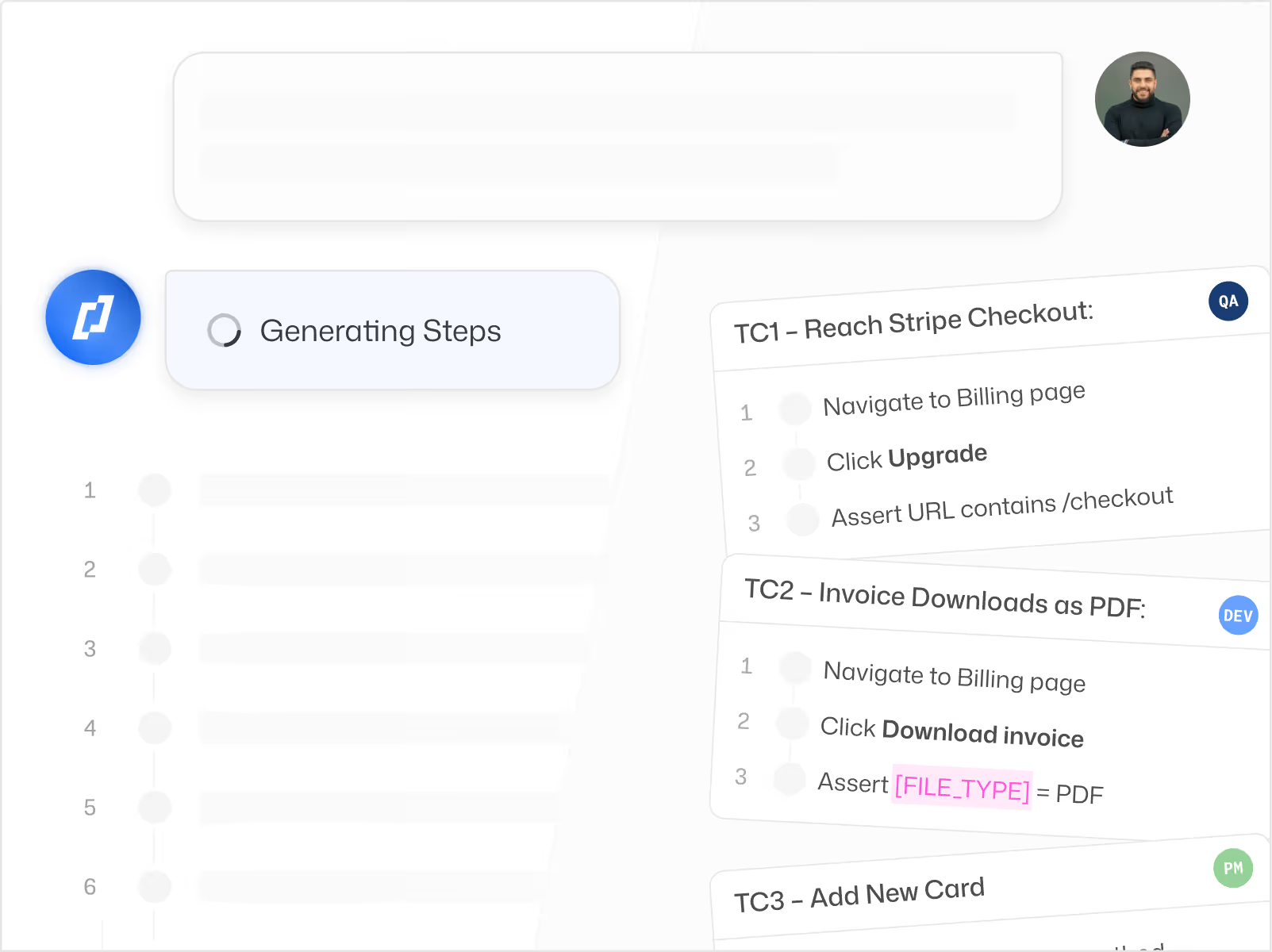
Your entire team can now write tests
Selenium’s code-first model limits test creation to engineers. Thunders opens testing to everyone: QA, product, and business teams write, review, and run tests through a clean, intuitive interface. No IDE. No CLI. No onboarding sprint.

No-code, natural language interface
AI-Powered Test Generation
Role-based access for all team profiles
Test your APIs as easily as your UI
API testing in Selenium requires external libraries, custom scripts, and a separate toolchain. In Thunders, you describe your API flows in natural language and Thunders handles authentication, assertions, and chaining across endpoints.
Native API testing, no extra setup
Automatic assertion and endpoint chaining
Unified UI and API test management


Plugs into your stack. Day one.
Selenium is a framework, not a platform. Every integration is your responsibility to build and maintain. Thunders connects natively to GitHub, GitLab, Jenkins, Jira, Linear, Xray, and more. Your CI/CD pipeline gets intelligent testing without the glue code.
Native CI/CD integrations (GitHub, GitLab, Jenkins)
Built-in connectors, zero maintenance
Issue tracking sync (Jira, Linear, Xray)
Thunders in action
Wondering if Thunders is a better platform for you? See this video walkthrough to learn the ins and outs of Thunders’ application and how it can help your team.
Frequently Asked Questions
What are the key differences between Thunders and Selenium ?
Selenium is a code-first framework that requires specialized engineers to write scripts in Java, Python, or JavaScript. Thunders.ai is a no-code AI platform that enables any team profile (QA, Product Managers, Business Analysts) to create tests using natural language. While Selenium is limited to executing scripted tests, Thunders.ai natively integrates AI generation, self-healing, AI Personas to simulate real users, and ready-to-use CI/CD integrations. Where Selenium laid the foundations of automation, Thunders builds the next generation: autonomous, intelligent, and accessible.
Why is Thunders easier to use than Selenium ?
Selenium imposes a steep technical barrier: every test means writing code, managing selectors, and handling assertions, meaning onboarding a new engineer can take several months. Thunders.ai allows anyone on the team to write tests in natural language. The platform instantly translates intent into executable steps without scripts or selectors. As a result, Product Managers, QAs, and Business Analysts become fully autonomous, creating and running tests in minutes rather than sprints. This accessibility expands the circle of quality contributors far beyond just developers.
How does Thunders reduce test maintenance compared to Selenium ?
With Selenium, every UI change breaks selectors: engineers spend up to 60% of their time fixing brittle tests that do not detect any real bugs, just obsolete locators. The more the product grows, the more technical debt accumulates. Thunders.ai tests understand what you are testing, not how it is technically built: when the UI changes, the tests automatically adapt thanks to self-healing logic. On a suite of 500 tests, weekly maintenance drops from around 12 hours with Selenium to about 30 minutes with Thunders, freeing teams to focus on quality rather than upkeep.
What are the real costs of Selenium vs. Thunders ?
Selenium is free as an open-source tool, but its true cost includes script development time, broken selector maintenance, grid infrastructure management, third-party reporting plugins, and engineer training. Thunders.ai is an all-in-one platform that natively integrates creation, execution, maintenance, reporting, and CI/CD integrations without needing to assemble additional tooling. The Total Cost of Ownership (TCO) must therefore be evaluated across the full cycle, factoring in Selenium's hidden costs. For many organizations, the boost in productivity and the elimination of technical “plumbing” tilt the scales in favor of Thunders.
How do you migrate from Selenium to Thunders ?
Thunders.ai allows you to import existing Selenium or Playwright scripts to facilitate the transition (a feature available with certain limits depending on script complexity). The migration is organized in several steps, starting with an audit of the existing test suite, followed by the identification of high-priority scenarios, a gradual recreation in Thunders (often accelerated by AI generation from specs or user stories), and finally a progressive switchover. There is no need to migrate everything at once; a phased scope-by-scope approach allows you to capitalize on existing assets while accelerating time-to-value. Thunders.ai offers dedicated onboarding to structure this transition based on each organization's specific goals.
Does Thunders support all browsers and environments like Selenium ?
Thunders.ai features natively integrated, parallel multi-browser execution with no grid configuration to manage. The platform covers standard cross-browser execution needs without the heavy infrastructure overhead required by Selenium. Selenium remains more flexible for highly specific edge cases (legacy browsers, exotic configurations) due to its historical WebDriver ecosystem. However, for the vast majority of modern projects, Thunders.ai offers equivalent coverage with simplified management and zero infrastructure to maintain.
What is the ROI of switching to Thunders ?
The ROI is driven by several factors, including a drastic maintenance reduction (from ~12 hours to ~30 minutes per week on 500 tests), faster time-to-market since tests are created in minutes rather than sprints, resource optimization by freeing developers from repetitive QA tasks, and the democratization of testing which allows business profiles to contribute directly to product quality. Additionally, it eliminates Selenium's hidden costs, such as infrastructure, third-party reporting plugins, and CI/CD integration maintenance. Translating these time savings into business value (more frequent releases, higher customer satisfaction, competitive responsiveness) easily justifies the investment.
How does self-healing test maintenance work in Thunders ?
Thunders.ai's self-healing relies on a fundamentally different approach than traditional tools. Instead of relying solely on technical selectors (CSS, XPath), the AI understands the intent of the test (what the user is trying to validate). When the UI evolves, the tests automatically adapt to the new structure without human intervention. Furthermore, AI-driven Root Cause Analysis (RCA) identifies the true reasons behind a failure, distinguishing actual regressions from harmless interface changes. This self-healing logic eliminates the endless cycle of broken locators and false positives, a capability completely absent in Selenium without complex custom developments.
Can Thunders completely replace Selenium ?
For the vast majority of modern use cases (functional, E2E, API, multi-browser, and regression testing), Thunders.ai can fully replace Selenium. It brings native, AI-powered features completely missing from the legacy framework, such as AI generation, Personas, self-healing, integrated reporting, and ready-to-use CI/CD integrations. While certain legacy contexts with heavy Selenium test debt may justify a temporary coexistence during the transition, Thunders.ai stands as a complete, autonomous alternative for organizations looking to modernize their QA, democratize testing, and reduce technical debt.
What Selenium limitations does Thunders solve ?
Selenium presents several historical limitations that Thunders.ai addresses natively. First, it removes the need to code by offering natural language test creation. It also eliminates heavy selector upkeep through AI-powered self-healing. Unlike Selenium, which is limited to scripted functional paths, Thunders provides intelligent AI Personas to cover SEO, accessibility, security, and edge cases. Reporting is fully integrated, delivering instant reports with visual proof and 1-click ticket creation, rather than relying on third-party plugins. Finally, Thunders resolves fragmented toolchains by offering native integrations (CI/CD, Jira, Linear, GitHub, Xray) and including native API testing within the same platform, without requiring external libraries. The platform also meets strict enterprise security demands with recognized certifications like ISO 27001, SOC 2, and GDPR.
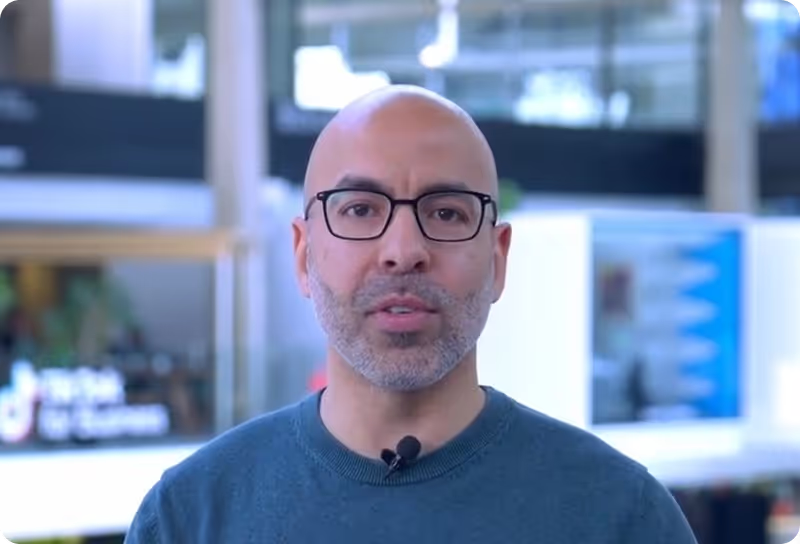
This is our QA of the future.
From the very first tests, Thunders caught real bugs in our interface — bugs that had slipped through all our standard quality processes.
Before Thunders, all UI testing was done manually. With Thunders, everything is end-to-end automated. Thunders lets us generate tests very quickly and improve the overall quality of our product.
Wassim Jouini
CTO @LegalPlace


Thunders is a whole new testing culture, not just another tool.
Automating our tests was a real challenge that classical automation simply couldn't solve. With Thunders, we were able to automate a hundred tests, with no technical expertise required.
Thunders opens up test automation to non-technical roles. Thunders bridges the gap between code and people. With Selenium, it used to take much longer.
Hanen Khalfaoui
QA Manager @Infopro Digital


What won me over with Thunders was the testing approach, the maturity, and the innovation.
Thunders delivers far greater resilience compared to classical automation. Thunders introduced a new variable in how we respond to RFPs — and it changes our entire economic model.
Today, Thunders is giving us a glimpse of more resilient tests and better maintainability of test suites. We run proofs of concept with Thunders to validate technologies for our clients.
Jean-Olivier Penin
Co-founder @B/Acceptance

Thunders enabled us to put quality and test creation in the hands of the entire product team.
Our PM teams covered 80% of our test scope in just six weeks with Thunders. After just one month, the entire team was up and running.
Tests are executable immediately and the onboarding was genuinely straightforward. Now it's the PMs who write test plans in plain language directly in Thunders.
Florian Ernoult
VP Engineering @agorapulse

See more Thunders Comparisons



Discover Thunders' features
Ready to ship faster with smarter testing?