Looking for an alternative to traditional QA tools?
Thunders vs Traditional QA Tools
Traditional QA platforms promised to industrialize software testing. Most delivered complexity instead of clarity. Here is what a purpose-built AI testing platform looks like when you start from scratch, and from the team’s actual needs.
Comparing Traditional QA Tools vs. Thunders

Traditional QA Tools
Thunders
Setup & Adoption
Intelligence & Maintenance
Collaboration & Integration
Traditional QA Tools
Thunders
Setup & Time to Value
Complexity vs. Intelligence
Maintenance at Scale
Accessibility & Collaboration
Here are a few reasons why now might be the time to move from traditional QA tools to Thunders
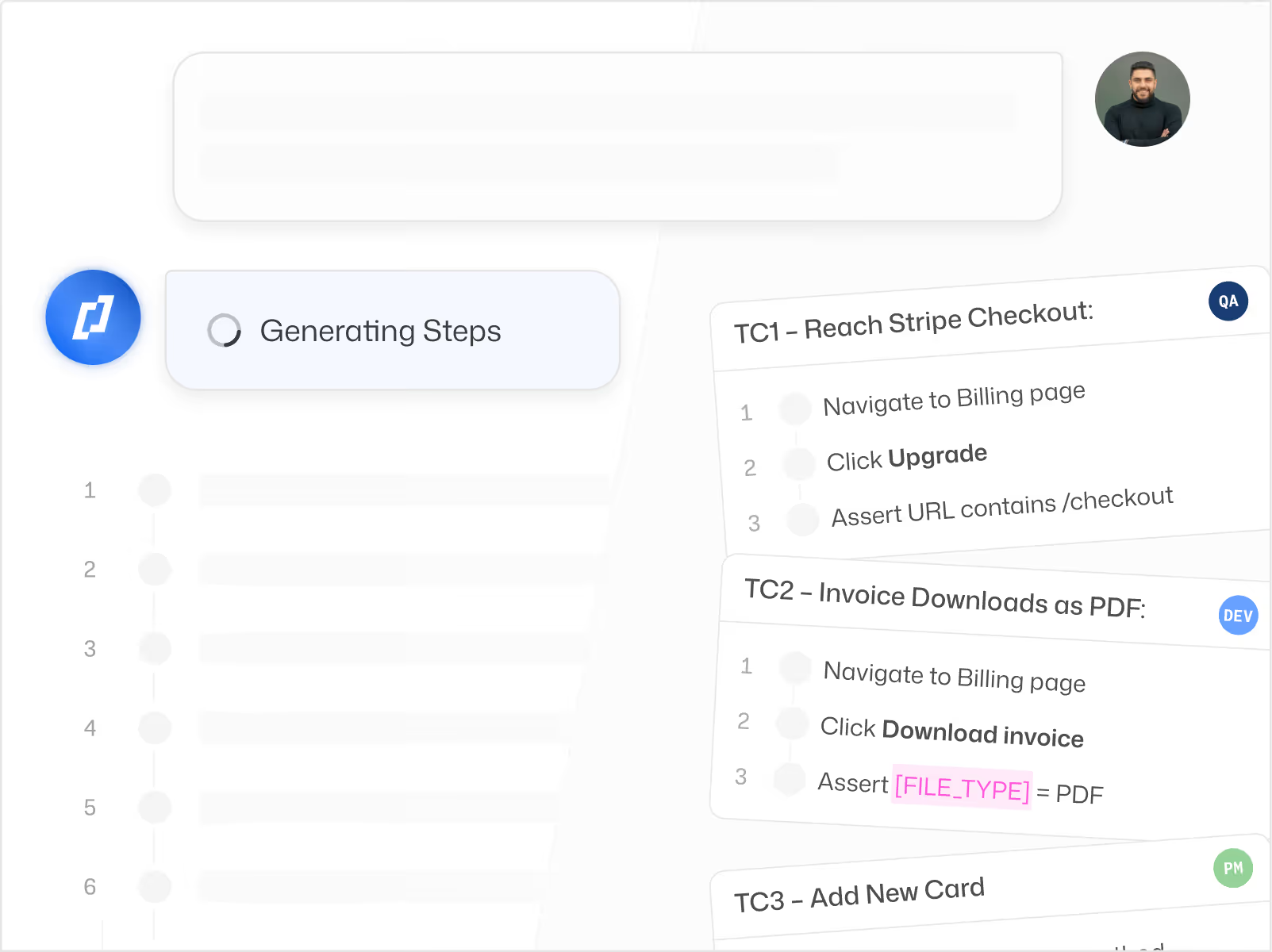
An interface your whole team will actually use.
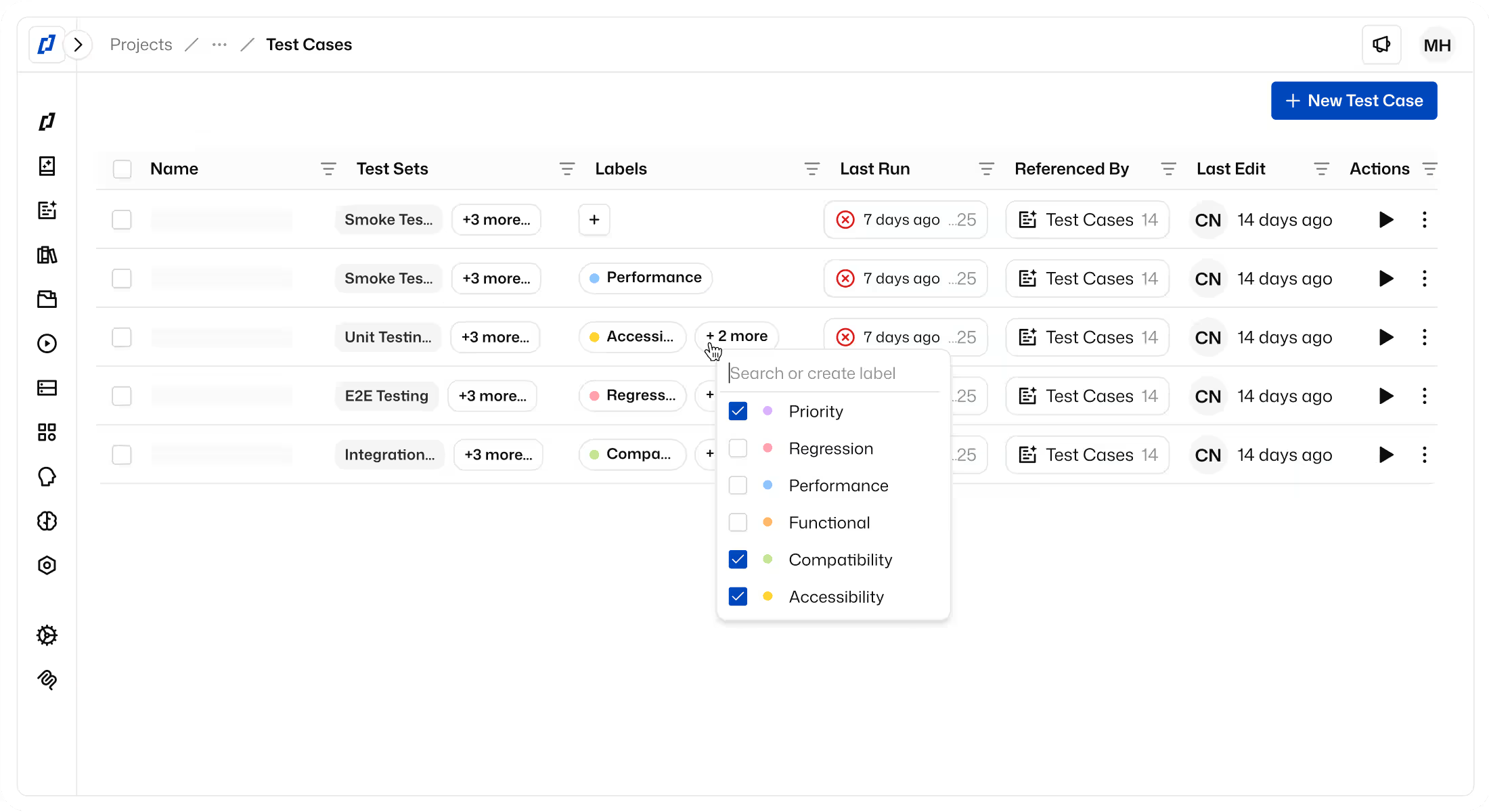
Traditional QA tools are feature-rich and user-hostile. Steep learning curves, specialized training, and complex navigation mean that adoption stays low and usage stays narrow. Thunders was designed to be picked up by anyone on your team in minutes, not mastered by a specialist over months. If your current tool needs a manual, it is already slowing you down.

No-code, natural language interface
AI-Powered Test Generation
Role-based access for all team profiles
API testing that does not require a separate tool.
In most traditional QA platforms, API testing is either an afterthought or a paid add-on that requires separate configuration and specialist knowledge. In Thunders, API flows are tested in plain language alongside UI tests; same platform, same interface, same reporting. Full product coverage without the vendor sprawl.
Native API testing, zero extra setup
Automatic assertion and endpoint chaining
Unified UI and API test management


Integrations that work out of the box.
Traditional QA platforms promise integrations and deliver connectors that require engineering effort to configure and maintain. Thunders plugs natively into GitHub, GitLab, Jenkins, Jira, Linear, and Xray from day one. Your CI/CD pipeline triggers tests automatically. Failures land as filed issues with full context. No custom glue code. No integration sprints.
Native CI/CD integrations (GitHub, GitLab, Jenkins)
Built-in connectors, zero maintenance
Issue tracking sync (Jira, Linear, Xray)
Thunders in action
Wondering if Thunders is a better platform for you? See this video walkthrough to learn the ins and outs of Thunders’ application and how it can help your team.
Frequently Asked Questions
What are the major limitations of traditional QA tools like Selenium, Cypress, and Playwright ?
Traditional QA tools present several structural limitations: they are designed for technical specialists, which effectively excludes Product Managers, Business Analysts, and Customer Success teams from test creation and analysis. Maintenance remains entirely the responsibility of humans: as test suites grow (to hundreds or thousands of tests), selector updates, environment drift, and brittle assertions tie up engineers who should instead be extending coverage. Added to this are heavy configurations, proprietary scripting languages, separate reporting plugins to install, and manual CI/CD integrations to build. Selenium, Cypress, and Playwright remain powerful for technical teams, but they were not designed for the daily release cadences of modern organizations.
How does Thunders use AI and autonomous agents to solve maintenance and cost issues ?
Thunders.ai replaces configuration complexity with artificial intelligence: instead of asking the team to learn a new script syntax, the platform learns what the team wants to test. Self-healing logic automatically adapts tests to UI changes, and flaky tests are detected and resolved before they pollute results. AI-driven Root Cause Analysis distinguishes real regressions from harmless changes, eliminating false positives. AI Personas (accessibility tester, SEO auditor, security tester) simulate real behaviors beyond the happy paths, extending coverage without manual effort. At scale, the team managing 50 tests handles 500 with the exact same effort.
What is the real ROI of Thunders compared to traditional frameworks and hidden costs ?
The ROI of Thunders.ai must be evaluated against the hidden costs of traditional frameworks: implementation projects lasting several months, dedicated consultants, onboarding programs spanning several weeks, specialized administrators to manage configurations, third-party reporting plugins, complementary tools for APIs or accessibility, and maintenance that grows proportionally to the size of the suite. Thunders eliminates these costs: no implementation project, no consultant required, no six-week integration program. Most teams have a functional test suite on day one. User feedback published on the Thunders site highlights a 50% reduction in regression test times thanks to parallel execution. ROI is also built on the democratization of testing, which frees engineers for higher-value tasks.
How does Thunders integrate into modern CI/CD pipelines and existing ecosystems ?
Where traditional QA platforms promise integrations and deliver connectors that require engineering effort to configure and maintain, Thunders.ai integrates natively with GitHub, GitLab, and Jenkins for CI/CD pipelines from day one. On the issue-tracking side, the platform synchronizes with Jira, Linear, and Xray to automatically turn test failures into logged tickets complete with full context. For teams using AI assistants (Claude, ChatGPT, Cursor, Devin, Windsurf), Thunders MCP allows them to manage tests directly from these tools without context switching. All of these integrations are maintained by Thunders, removing the technical plumbing burden usually associated with classic QA tools.
Why are AI/no-code platforms like Thunders becoming essential in 2026 ?
Traditional QA platforms were designed in an era when software was delivered quarterly. In 2026, teams deliver daily, and QA can no longer be siloed into a specialized department that becomes a bottleneck. AI/no-code platforms address this structural shift: they allow the entire team (QA, Product, Business) to contribute to quality, automate maintenance through self-healing, and extend coverage using AI agents that simulate real user behaviors. Added to this is compliance with the modern requirements of large organizations: Thunders.ai is SOC 2 certified, ISO 27001 certified, and GDPR compliant. Quality becomes a shared discipline integrated into the teams' daily workflow, rather than an isolated phase.
Which team profiles benefit the most from Thunders vs. traditional tools ?
Thunders.ai benefits a much wider range of profiles than traditional tools, which remain reserved for QA specialists and developers. QA engineers gain autonomy over strategy and coverage, freed from manual maintenance. Product Managers can validate user journeys themselves without depending on developers' schedules. Business Analysts and Customer Success teams check critical paths in natural language without having to interpret technical logs. Meanwhile, developers and DevOps benefit from native CI/CD integrations and Thunders MCP to run tests from their AI assistants. Quality becomes a shared discipline rather than an isolated department.
How do you migrate from a traditional QA approach to an autonomous AI platform ?
The migration is generally organized in several stages: auditing the existing test assets, identifying the high-priority scenarios to migrate (critical paths, main regression suite), progressively recreating them in Thunders.ai (often accelerated by AI generation from specs, user stories, or Figma mockups), and then transitioning gradually with a temporary coexistence of both approaches. Thunders MCP can automate the conversion of existing Selenium, Cypress, or Playwright scripts into executable test cases, avoiding manual rewriting. There is no need to migrate everything at once: a phased, scope-by-scope approach allows you to capitalize on existing assets while accelerating value. Thunders' minimal learning curve also eases change management, as teams become productive from day one.
Can Thunders really eliminate the need for developers in testing ?
Thunders.ai does not aim to eliminate developers, but to free them from repetitive test creation and maintenance tasks so they can focus on higher-value topics. The platform allows non-technical profiles (QA, PM, Business) to create and run tests autonomously, removing systematic dependency on developers for every new scenario. Developers retain a key role in quality strategy, CI/CD integration, test architecture, and highly technical cases. Concretely, the developer shifts from an operational role (writing and maintaining scripts) to an architectural role (defining quality strategy), which values their expertise while accelerating the team's overall cadence.
Do AI/no-code platforms like Thunders offer the same level of flexibility for complex scenarios as code-based frameworks (Cypress/Playwright)?
While 95% of tests (E2E, API, mobile) can be effortlessly created using natural language or AI generation, the platform never sacrifices flexibility. For highly edge-case scenarios, such as low-level manipulation of third-party auth tokens, custom script injections, or bespoke asynchronous workflows, Thunders allows you to inject custom code blocks or advanced requests. Unlike first-generation no-code tools that locked users out as soon as they veered off the beaten path, Thunders delivers the speed of no-code for the vast majority of tests without ever placing a technical ceiling on your most complex scenarios.
How does Thunders handle complex test states like authentication (MFA, tokens) and network mocking compared to Playwright?
In Playwright, managing sessions, auth tokens (JWT), and API mocking requires writing specific configuration scripts. Thunders radically simplifies this process without sacrificing technical depth. The platform's AI natively understands and executes complex authentication flows, including MFA and session persistence across tests. Furthermore, for mocking needs or isolated API testing, Thunders integrates advanced visual features to intercept and modify network requests with a single click. You get the exact same technical granularity as Playwright, without the code complexity.

This is our QA of the future.
From the very first tests, Thunders caught real bugs in our interface — bugs that had slipped through all our standard quality processes.
Before Thunders, all UI testing was done manually. With Thunders, everything is end-to-end automated. Thunders lets us generate tests very quickly and improve the overall quality of our product.
Wassim Jouini
CTO @LegalPlace


Thunders is a whole new testing culture, not just another tool.
Automating our tests was a real challenge that classical automation simply couldn't solve. With Thunders, we were able to automate a hundred tests, with no technical expertise required.
Thunders opens up test automation to non-technical roles. Thunders bridges the gap between code and people. With Selenium, it used to take much longer.
Hanen Khalfaoui
QA Manager @Infopro Digital


What won me over with Thunders was the testing approach, the maturity, and the innovation.
Thunders delivers far greater resilience compared to classical automation. Thunders introduced a new variable in how we respond to RFPs — and it changes our entire economic model.
Today, Thunders is giving us a glimpse of more resilient tests and better maintainability of test suites. We run proofs of concept with Thunders to validate technologies for our clients.
Jean-Olivier Penin
Co-founder @B/Acceptance

Thunders enabled us to put quality and test creation in the hands of the entire product team.
Our PM teams covered 80% of our test scope in just six weeks with Thunders. After just one month, the entire team was up and running.
Tests are executable immediately and the onboarding was genuinely straightforward. Now it's the PMs who write test plans in plain language directly in Thunders.
Florian Ernoult
VP Engineering @agorapulse

See more Thunders Comparisons




Discover Thunders' features
Ready to ship faster with smarter testing?