
TLDR
Discover how to transform your QA strategy from a manual cost center into an automated growth lever by mastering ROI calculation and adopting AI tools to finally break the cycle of infinite maintenance.
If you need to defend a QA budget, you already know the trap: compared to ai qa automation, manual testing appears "free" because it's already built into the team. Except that at the scale of a fast-moving product, it can quickly become very expensive.
Here is the true cost of manual testing:
- Slowed release cycles (feedback loop too long),
- Bugs that make it to production (and cost far more to fix),
- Teams that spend their time repeating work instead of improving the quality strategy,
- And, paradoxically, "classic" automation that sometimes ends up generating… its own maintenance debt.
This article resets the counters: ai qa automation, economic models (manual vs automated software testing), tool selection (Selenium/Cypress/Playwright), CI/CD integration, ROI calculation. You will also see why AI has become the logical next step to reduce maintenance costs.
In summary :
- Definition: AI qa automation consists of using software to execute repetitive tests, reducing dependence on costly and fallible human intervention.
- The manual problem: manual testing has a linear cost (more tests = more time/money), while automation is an investment with decreasing marginal cost.
- Key benefit: test automation reduces time-to-market and limits the cost of bugs discovered in production (often far more expensive than when detected early).
AI QA Automation: Definition and the Break From the Manual Model
Automating means transforming a variable cost (human time) into an asset (scripts, scenarios, agents) that executes on demand, at scale.
Why We Talk About a "Break" With Test Automation
Manual testing scales poorly. Structurally:
- If you double manual test coverage, you roughly double the time spent.
- If you double release frequency, you also double the volume of re-tests.
- If you add variations (browsers, devices, configurations), you multiply the effort.
With ai qa automation, the logic changes:
- The initial investment can be significant,
- But the marginal cost of execution becomes low (machine time),
- And most importantly, you can execute more often, earlier, and more systematically.
The Quantifiable Benefits
- Execution speed: automated suites run much faster than a human on repetitive tests (in the order of x100).
- Availability: 24/7, aligned with CI/CD (no "office hours" or "when the QA team is available").
- Reliability: no fatigue or inattention errors on repetitive tasks.
The important nuance: automation doesn't eliminate human QA. It shifts the value less "robotic" work, more strategy (risk, exploration, product quality).
The True Cost of Manual Testing (The Hidden Analysis)
Manual testing is expensive because it adds up direct costs, opportunity costs, and delay costs and all three explode when the product accelerates.
1) The Direct Cost: Salary × Repetition Time
This is the only cost that's immediately visible. The QA re-tests the same flows:
- Login,
- Object creation,
- Payment,
- Permissions,
- Export, etc.
Manual testing is useful, but manually repeating non-regression checks quickly becomes a disguised budget line item.
2) The Opportunity Cost: What Your QA Engineers Are No Longer Doing
While a QA engineer spends 2 hours re-testing a form, they are not conducting exploratory tests or improving business alignment. Shifting to collaborative test management is precisely what re-engages Product Managers and developers in the quality strategy, freeing QA experts for higher-value tasks:
- No exploratory testing on risk areas,
- No improvement of quality observability,
- No help for the product team in defining more testable acceptance criteria,
- No reinforcement of the regression strategy.
You pay twice: the time + the quality not created.
3) The Cost of a Slow Feedback Loop
When you discover a problem 2 days after a PR, at the end of a sprint, or worse in production, the cost bears no relation to that of a bug detected immediately. The later feedback arrives, the more expensive the fix (and the more it disrupts the roadmap).
Comparison Table: Manual Model vs AI QA Automation
| Criteria | Manual Testing | AI QA Automation |
|---|---|---|
| Execution cost | High (paid by the hour) | Low (machine time) |
| Scalability | Low (requires hiring) | Unlimited (cloud) |
| Error risk | Increases with fatigue | More consistent (near 0) |
| Feedback delay | Hours / days | Minutes |
| Maintenance cost | None (starts from scratch) | Lower (via AI) |
The "surprising" point: manual testing has no maintenance cost… because it recreates the execution cost at every run. Nothing is maintained, everything starts over each time.
Process: Moving From Manual to Automation Without Breaking the Bank
The most cost-effective way to automate is to apply an 80/20 approach, starting with what is repetitive, critical, and stable. Avoid the "everything, all at once" approach.
The 80/20 Rule: What to Automate First
Prioritize automating:
- Smoke tests (vital checks),
- Critical flows (login, payment, onboarding, core workflows),
- Stable tests (not in permanent refactoring),
- High-frequency regression tests,
- Contract tests if your architecture is microservices or API-oriented: they verify that exchanges between services respect an expected format, without having to deploy the entire system. High ROI, low maintenance.
The "100% All at Once" Trap
Wanting to automate 100% immediately is often more expensive than:
- Staying temporarily with manual testing,
- Then automating progressively.
Why? Because you end up automating unstable areas paying in maintenance and losing confidence (risk of tests that break constantly).
The profitable steps:
- Smoke tests: vital verification.
- Critical flows: where a bug costs the most (payment and login in particular).
- Edge cases: once the foundation is solid.
This progression gives you an actionable quality signal quickly, without turning automation into an endless project.
Frameworks and Tools: Investment vs Maintenance
The right tool is not the one that "runs tests", it's the one that minimizes your TCO (Total Cost of Ownership): setup time + maintenance cost + ability to keep up with your releases.
The question here is not "which is the best technically." The question is: how much does it cost to maintain?
Selenium (The Aging Standard)
- Advantage: very widespread, enormous ecosystem, free to install.
- Hidden cost: often verbose, fragile scripts, heavy maintenance if the app evolves quickly.
Selenium can be cost-effective if you already have the expertise and a relatively stable app. Otherwise, TCO can climb quickly.
Cypress (The Developer Favorite)
- Advantage: pleasant interface, quick to set up, good fit for modern front-end.
- Limitations: certain complex scenarios (e.g., multi-tab) can be more constraining.
Cypress is often a good choice if you want fast onboarding and front-end-oriented E2E tests with an involved dev team.
Playwright (The Robust Challenger)
- Advantage: very good performance/cost ratio for coded tests, cross-browser support, solid for modern suites.
- Pain points: like any scripted framework, you pay for maintenance as soon as UI or flows change frequently.
Playwright is often an excellent compromise when you accept the scripted model. But the scripted model retains a structural problem: tests memorize the implementation.
Reducing Maintenance Cost: This Is Where AI Becomes Relevant
The next step to reduce maintenance costs is AI, notably self-healing. The idea: limit the fragility linked to selectors and UI variations, without constantly rewriting scripts.
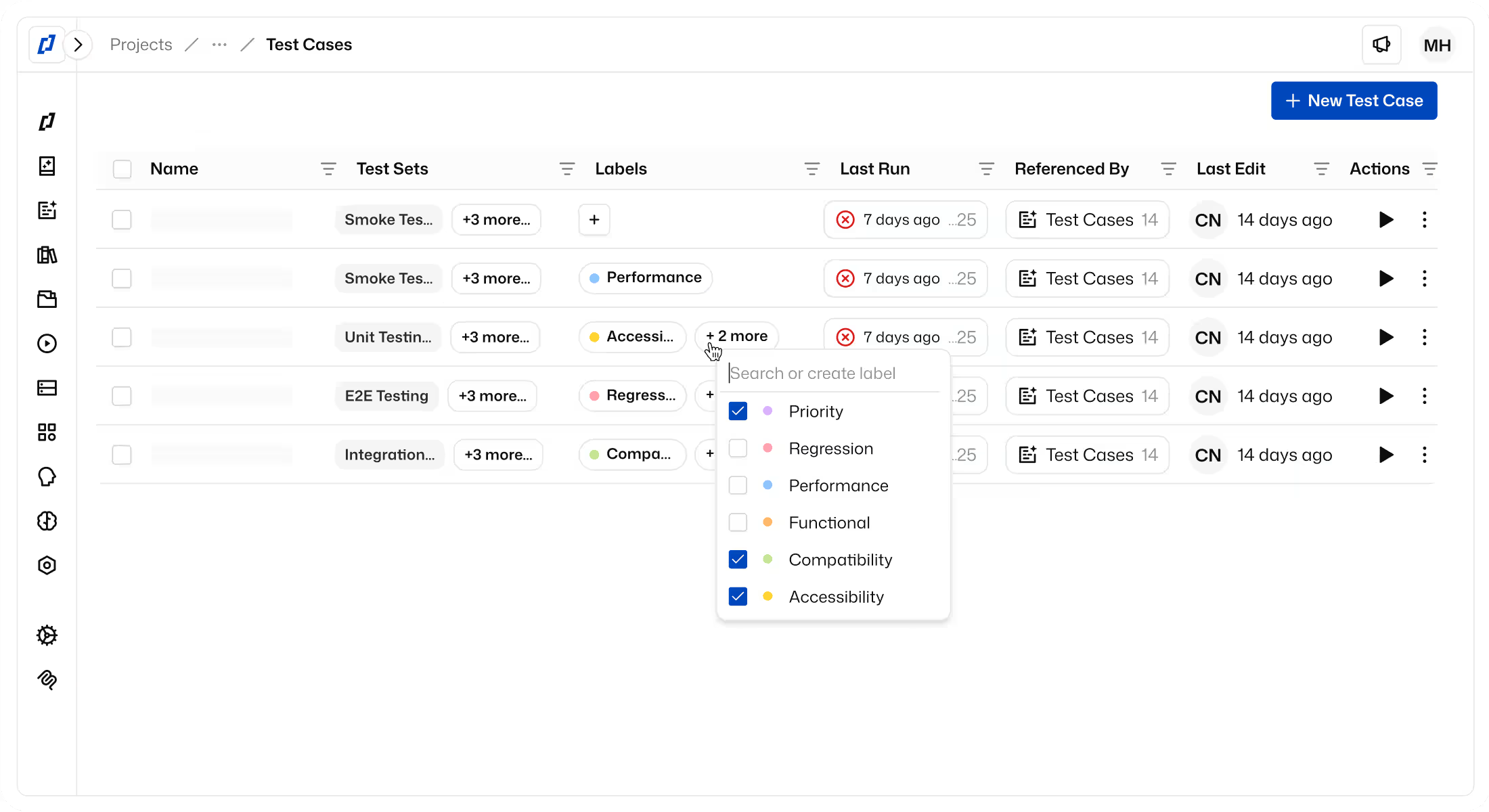
This is precisely what Thunders offers: reducing the cost of manual testing, but also the hidden cost of classic automation, by moving from a "fragile scripts" logic to a more adaptive one (agents, self-healing, guided execution).
Test Scripts: An Asset or a Liability?
A script is an asset only if it is designed to last. Otherwise, it becomes a test debt that costs more to maintain than testing manually.
The Concept of "Test Debt"
A poorly written automated test:
- Breaks frequently,
- Requires permanent fixes,
- Destroys confidence,
- And ends up being disabled (therefore zero ROI).
At that point, you have paid:
- The creation time,
- The maintenance time,
- And you're back to manual testing.
Best Practices to Reduce Costs
- Atomic scripts: each test verifies one thing only and doesn't depend on another test to run. Result: when a test breaks, you know exactly why.
- Page Object Model (POM): interface elements (buttons, forms, pages) are described once in the code. If the UI changes, you only modify one place instead of going through all your scripts.
- Data-driven testing: test data is separated from the scenario. The same test can run with ten different data sets without rewriting. Less duplication, less maintenance.
These practices make the difference between a suite that scales and a suite that becomes a second product.
AI QA Automation and CI/CD: Securing Revenue
CI/CD + ai qa automation = the ability to deploy more often without increasing risk. Concretely: fewer rollbacks, fewer incidents, more velocity.
The Direct Link to Business
In CI/CD, the problem isn't "deploying." The real problem is "deploying without fear." AI qa automation delivers:
- A safety net against regressions,
- A fast signal on quality,
- A reduction in "hotfix" cycles.
The True Cost of a Rollback
A rollback is not just a technical action. It is:
- Emergency team energy,
- Last-minute fixes,
- A trust debt with users,
- Sometimes direct losses (conversion, churn, SLA).
Automating key checks in CI means blocking defective code before production and saving real costs (support, fixes, brand reputation).
If your trajectory is toward more autonomy (agents, self-healing, scenario generation), this article completes the subject well: autonomous tests and AI agents.
Calculating ROI (Return on Investment)
The ROI of ai qa automation is calculated by comparing the manual time saved to the maintenance time of automated tests, then dividing by your hourly cost.
The Simple Formula
ROI = (Manual time saved, Script maintenance time) × Hourly cost
This calculation allows you to frame a budget discussion without overwhelming the decision-maker.
To make it realistic, add two layers:
- Execution frequency (the more often you execute, the more profitable automation becomes),
- Cost of a late bug (the later a bug is detected, the more expensive it is).
The Qualitative ROI (The Underestimated One)
ROI must also take into account these qualitative factors:
- Better team morale: repetitive, low-value tasks are a recognized source of disengagement among experienced QA profiles. Automating regression testing is also a retention lever, your experts spend their time on subjects that help them grow. This is a concrete argument for an HR Director or CPO looking to retain technical talent.
- Better product image: fewer visible regressions in production means fewer support tickets, less silent churn, and a better perception of your product's reliability, difficult to quantify, but real and cumulative.
- Better delivery capacity: teams that deploy without fear deliver more often. This velocity gain directly translates into a competitive advantage on time-to-market.
The Mistakes That Kill ROI
Key warning points:
- Automating unstable features (infinite maintenance),
- Building a suite too tightly coupled to the implementation,
- Neglecting CI/CD integration (tests that run "when we have time").
To reduce maintenance costs, the item that destroys ROI, the Thunders approach specifically aims to lower the TCO of automated tests through more adaptive and less fragile execution.
If you want to understand the product approach, don't miss the Thunders product page.


.png)