
TLDR
Software test automation, now essential for accelerating releases without sacrificing quality, is breaking free from the complexity and technical debt of traditional scripts thanks to the rise of intelligent, no-code, and AI-powered approaches like self-healing.
- Smart testing describes a software testing approach where artificial intelligence takes over the generation, execution, prioritization, and self-healing of tests.
- No more rigid scripts that break the moment an interface changes: intelligent tests adapt, learn, and optimize continuously.
- For QA, DevOps, product, and business teams, this is a genuine paradigm shift: less maintenance, more reliability, faster releases.
- Thunders embodies this approach by letting you build and run complete end-to-end (E2E) tests in plain English, with up to 88% less maintenance.
It runs fast, sure, but it's become brutally expensive to maintain. With UIs that shift constantly (design systems, product iterations, A/B tests, front-end refactors), teams increasingly spend their time babysitting their test suites instead of improving software quality.
Smart testing isn't about bolting an "AI layer" onto your existing framework. Think of it as a deeper shift: moving from deterministic scripts (fragile by design) to intelligent software tests that absorb change, prioritize themselves, and surface diagnostics you can actually act on. The goal is a measurable operational gain.
What is smart testing?
Smart testing (also called AI testing) is a fundamental evolution of software testing in which AI doesn't just execute test cases; it understands the intent, adapts execution, and cuts the maintenance tied to implementation changes.
The traditional approach relies on scripts: brittle selectors, unstable locators, and constant upkeep every time an ID changes or a component gets refactored. Smart testing flips the logic. It targets functional validation and the robustness of user journeys, drawing on data analysis, heuristics, and (depending on the solution) visual test design.
From traditional test automation to smart testing: what actually changes
Tools like Selenium or Cypress memorize the implementation. Smart testing sets out to understand the objective.
- Traditional test: "click on #btn-add-to-cart"
- Intelligent test: "add a product to the cart"
A concrete example: a button gets renamed, or its CSS class changes. A scripted test breaks. An intelligent test can recognize intent through text, UI context, accessibility attributes, or visual patterns (depending on the solution).
This is where concepts like model-based testing, visual test design, and data analysis start to matter: the AI doesn't execute blindly; it leans on a model (even a lightweight one) of expected behavior and on signals observed at runtime.
The core components of a smart testing system
A solid smart testing system assembles several building blocks, ideally within a fluid testing chain:
- Automatic generation (GenAI / text-to-test)
- Intelligent execution (dynamic navigation, handling variations)
- Self-healing test automation
- Advanced reporting (diagnostics, root causes, traceability)
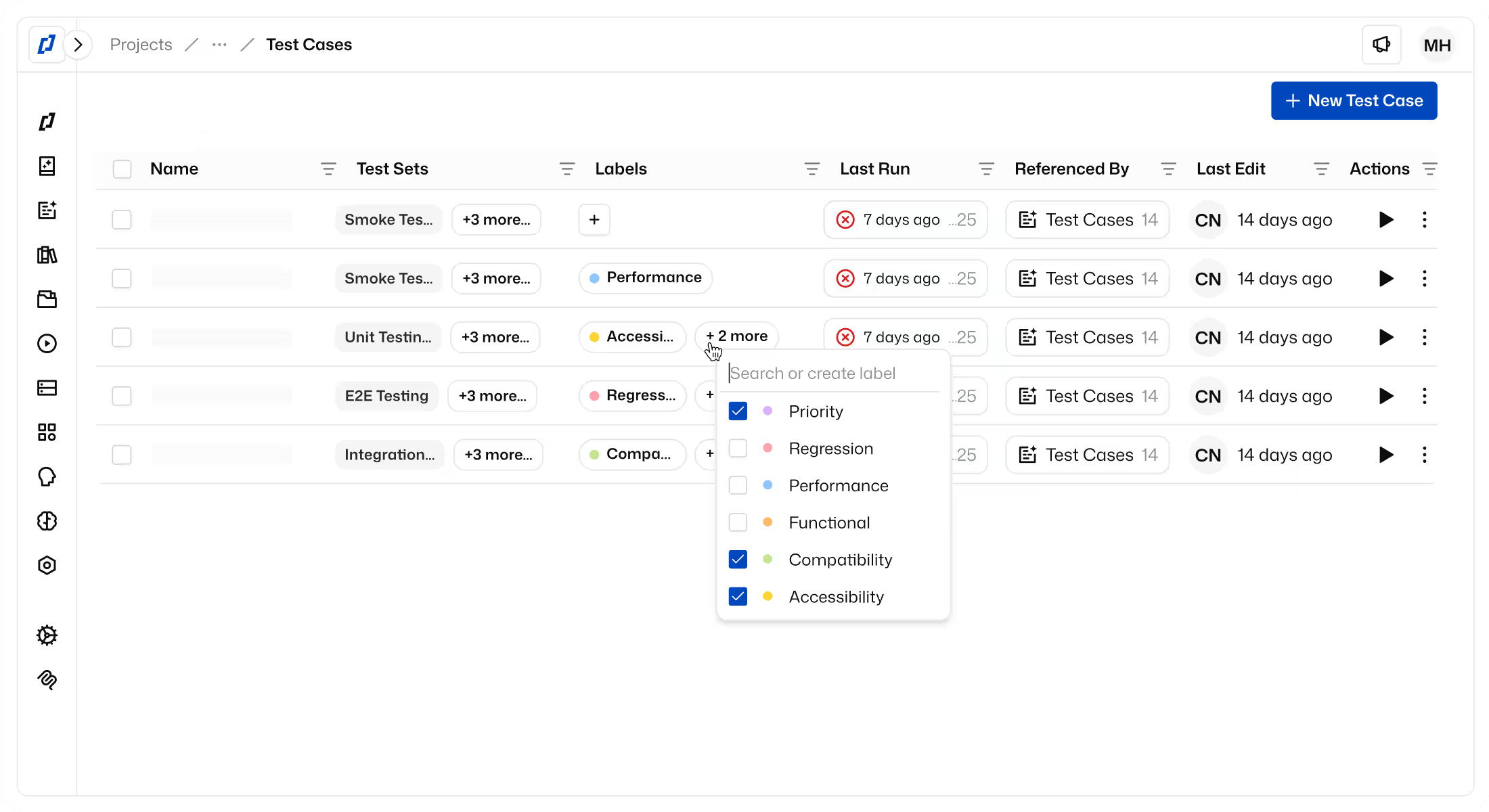
Thunders is a platform that integrates these components natively: natural-language authoring, E2E execution, debugging, and integrations across your stack (CI/CD, issue trackers, and more).
Tests that learn and adapt
What sets AI testing apart is continuous learning: tests become more robust with every run, instead of going stale with every release.
Why do traditional tests degrade under continuous delivery? Because they "freeze" technical details (the DOM, locators, timings). And in CI/CD, those details change all the time. AI testing aims to stabilize what actually matters: the business and QA intent.
Self-healing test automation: when the test fixes itself
Self-healing rests on a simple mechanism: the AI detects that an expected element has changed (structure, attributes, position) and updates how it identifies that element, with no manual rewrite required.
The impact on maintenance debt can be massive: up to 88% less maintenance with tools like Thunders compared to traditional approaches.
A concrete example: a form gets redesigned (placeholders, structure, labels). Instead of breaking the whole suite, the system adapts its anchor points. For a team that goes through frequent redesigns, that changes daily life, especially for QA teams and test engineers who want to stop the endless cycle of "repairs."
Learning from usage: tests that get more relevant over time
AI testing improves through use: the more executions it observes, the better it understands the "normal" variations of a user journey (latency, dynamic content, browser differences) and tells them apart from genuine regressions.
More advanced approaches also talk about digital twins and virtual trials: simulating scenarios and datasets to anticipate behavior before a bug ever "leaks" into production.
A use case: a test spots an anomaly on a new browser (or a new version) without any explicit reconfiguration, because it has learned what to expect and what not to.
Natural language testing: the key to accessibility
Plain English (natural language) is what makes AI testing user-friendly: you describe a test the way you'd write a Jira ticket or a user story, and the tool turns it into an executable run.
Example:
"Verify that a user can sign up, add a product to the cart, and check out"
becomes an immediately runnable E2E scenario.
The consequence: QA, product managers, and business teams can create tests without depending on a developer. That's exactly the "scriptless" positioning behind Thunders. (Worth trying: a free trial, no coding required.)
Auto-optimization and intelligent test prioritization
In CI/CD, you can't test everything on every deployment. AI testing prioritizes intelligently to protect delivery speed without sacrificing reliability.
Risk-based prioritization
The AI analyzes failure history, high-risk areas, and critical paths, and can recommend (or trigger) the tests that maximize business value first.
The idea isn't to test less. It's to test better: the same useful coverage, less wasted time, better energy efficiency across the pipeline (less pointless compute), and smoother releases.
Reducing flaky tests
Flaky tests are costly false positives: they waste time, erode trust in the pipeline, and trigger repeated reruns.
The orders of magnitude are often high: some ROI analyses suggest teams can spend 15% to 40% of their time on maintenance (test automation included). AI testing aims to free up part of that time by reducing fragility and stabilizing the signal.
For QA teams and test engineers, the stakes are twofold: strip out the noise (flakiness) and reclaim time for high-value work (exploratory testing, strategy, risk analysis).
Intelligent reporting and root cause analysis
Reporting isn't just a dashboard; it's a lever for continuous improvement. "Intelligent" reporting should help you answer, fast: what broke, where, why, and what to do about it?
Thunders offers fast reports, actionable analysis, and integrations that smooth out the workflow (CI/CD, GitHub, Jira, and more).
To see the solution in detail, click here: Thunders AI testing platform.
Smart testing use cases by industry
Smart testing is relevant anywhere software ships. It's especially critical in sectors with sensitive journeys, high release cadence, and/or zero tolerance for failure.
Finance and fintech: zero tolerance for anomalies
Automated validation of payment flows, authentication, compliance, and security checks. The goal: cover critical journeys 24/7 without relying on manual campaigns.
E-commerce and retail: protect the conversion funnel
Automatically test cart, checkout, and confirmation across mobile and desktop on every deployment. Here the impact is direct: an anomaly in the funnel means lost revenue, straight away.
SaaS and software vendors: ship faster without sacrificing quality
DevOps teams want native integration into the CI/CD loop: tests on pull requests, runs on every commit, fast results.
Business and product teams: validate without depending on developers
For business analysts: write the acceptance criteria, then turn them into Thunders tests and run them autonomously. For product and delivery teams: validate a user story before sprint review without waiting on QA.
The leading AI testing tools in 2026
Choose a tool based on its maturity, its use cases (UI, API, E2E), its CI/CD integration, and its compliance posture (GDPR, SOC 2, and so on).
Thunders: the next-generation AI testing agent
Thunders leads with: natural-language generation, self-healing, cross-browser support, CI/CD integration, and ISO 27001, SOC 2, and GDPR compliance.
Recommended for: all profiles, from QA to business, with no coding skills required.
Smartesting and SmartBear: the established players in intelligent testing
- Smartesting: specialized in model-based testing and visual test design.
- SmartBear (TestComplete, ReadyAPI): an enterprise platform oriented toward functional and API testing.
Strengths: enterprise coverage, functional depth. Limitations: learning curve, cost, need for technical expertise.
AI testing tools comparison
| Tool | Approach | Strengths | Limitations | Best for | GDPR compliant |
|---|---|---|---|---|---|
| Thunders | AI agents + natural language + self-healing | Accessibility, E2E, CI/CD, less maintenance | Governance/oversight to be scoped | QA, DevOps, PM, Business | Yes (per published info) |
| Smartesting | Model-based testing | Modeling, visual design | MBT method to adopt | QA / quality architects | Varies |
| SmartBear | Enterprise UI/API suite | Broad coverage | Complexity / cost | Large QA/IT teams | Varies |
| Traditional tools | Selenium / Cypress / Playwright scripts | Fine-grained control | High maintenance, UI fragility | QA / devs (code) | N/A |
You can also check out this comparison of smart testing tools.
ROI and operational gains of smart testing
The ROI of smart testing comes down to time saved + bugs avoided, minus the cost of the solution. And it peaks when scripted maintenance has already become a form of debt.
Method: ROI = (time saved × hourly cost + bugs avoided × average cost) − cost of the solution
What AI testing really wins you
- Up to 88% less maintenance (to be contextualized by maturity, stack, and UI stability)
- Faster test creation (the "text-to-test" effect)
- Earlier detection in the cycle (far cheaper than fixing in production)
ROI at a glance (before / after)
| Metric | Before AI testing | After AI testing | Expected impact |
|---|---|---|---|
| Maintenance time / week | 12 h | 2–4 h | −60% to −85% |
| Useful E2E coverage | Average | Higher | + critical journeys |
| CI feedback time | Long | Shorter | Faster releases |
Data security and AI ethics in testing
Fair questions: where is data hosted, who has access, and how are artifacts (logs, screenshots, scenarios) used? Thunders points to ISO 27001, SOC 2, and GDPR compliance, plus a dedicated trust/compliance center.
The human-in-the-loop remains a solid safeguard: the AI executes and proposes; humans oversee the sensitive decisions.
How to learn and level up on smart testing
Leveling up means learning a QA value chain: intent, risk, oversight, reporting.
You can do it through existing certifications and training in the QA ecosystem (ISTQB AI Testing, community resources), as well as through the resources in the Thunders help center: documentation, help center, CSM support, and more.
Conclusion
Smart testing delivers more reliable tests, drastically reduced maintenance, and faster releases, provided you keep a pragmatic approach (oversight, governance, security).
Ready to move from traditional testing to AI testing? Thunders generates, runs, and self-heals your E2E tests in plain English, without writing a single line of code, across all your browsers and environments.