Client stories
How LegalPlace’s QA went from fixing broken tests to owning quality across every team
From a manual UI backlog and flaky Playwright scripts to a QA lead running parallel test cycles across feature releases, without writing a line of code.

The Challenge
Manual UI testing and brittle automation couldn't scale. Unit tests were automated, but everything else from UI flows to end-to-end scenarios, was handled manually. Playwright scripts broke with every UI change, leaving the team maintaining tests instead of running them. Keeping QA aligned with the pace of the product was a constant challenge.
The Solution
Natural language tests that adapt to UI changes automatically. Thunders let the QA team write tests in plain language, and the tests self-heal as the UI evolves. No more chasing broken selectors and manual UI runs.
Key results

From the 1st session
real bugs caught in production, before deployment was even complete

A few days
for a QA team with no prior experience with the tool to be fully operational

One QA lead
now drives quality across multiple product teams in parallel

1 sprint
where manual passes, Playwright fixes, and validation used to take several
Before Thunders
A backlog of untested UI and tests that kept breaking. LegalPlace is a LegalTech platform that lets businesses create and manage their company, handling everything from registration to domiciliation, banking, accounting, and insurance. Their product moves fast. Their test coverage didn't. Unit tests were automated through Playwright. But the UI layer was still tested by hand: slow, inconsistent, and impossible to scale with how often the product shipped. And every time the interface changed, the existing Playwright scripts broke, eating into time that should have gone toward shipping. Testing had become a bottleneck: manual, repetitive work that delayed releases and wore down the team.
Implementation
Onboarding in days, tests running the same week. Thunders was up and running almost immediately. The QA lead, new to the tool, picks it up without friction. There's no syntax to learn. He takes existing use cases and implements them directly. Within days, he was running real tests against production flows. The first session was revealing: Thunders flagged real bugs already live in production, issues that had slipped through the existing QA process entirely. Both original blockers were gone within the first week. Self-healing tests removed the maintenance burden on Playwright scripts. Automated UI execution replaced the manual UI runs, with the QA lead authoring everything in plain language.
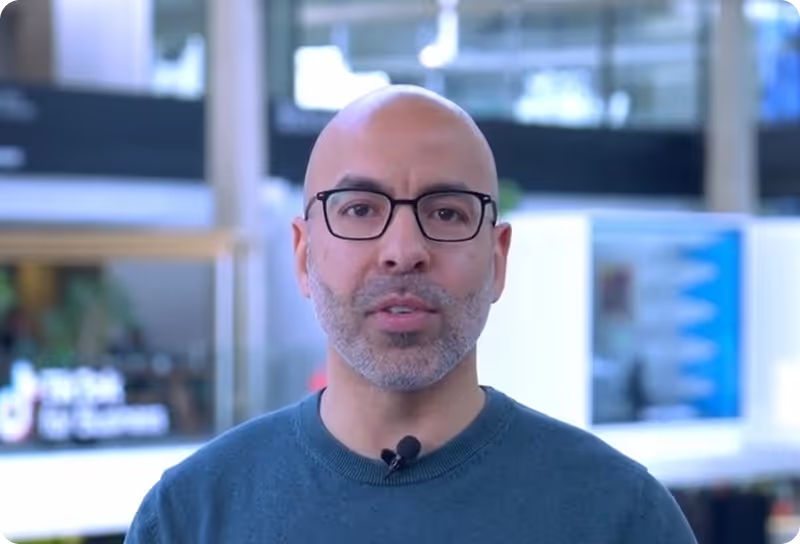
Thunders gives us the leverage of a full QA team.
Wassim Jouini
CTO @LegalPlace
Result
More coverage, faster releases, and a QA team that finally leads. The shift in how QA works at LegalPlace has been structural. The QA lead no longer spends time keeping broken tests alive. He spends it building test matrices with feature teams, implementing them in Thunders, and validating releases as part of the sprint. Each new feature follows the same process: the QA lead works with the team to define what needs testing, writes the tests in plain language, and runs them before the release goes out. The process is fast enough that multiple feature teams can run in parallel without compromising coverage.












Ready to ship faster with smarter testing?