
TLDR
A superintelligent AI QA engineer wouldn't run more tests. It would change which questions get asked, when, and how much you can trust the answer. This thought experiment lists eight traits such a tester would have: it reads every change before it ships, remembers every bug ever filed, explores paths nobody mapped, decides what not to test, knows when to test, knows what "correct" looks like, has taste, and shows its work. We then walk through one release week in 2030, show how each trait maps to what Thunders' agents already do today, and give three habits any QA team can adopt now. The short answer to "can QA be superintelligent?" is that the intelligence was never the bottleneck. Maintenance was.
Can quality assurance be superintelligent? Most answers start with the model, the benchmarks, the architecture. That's the wrong place to start.
Start with the job. Picture a QA engineer with no limits: never tired, never behind on the backlog, never tempted to skip a flaky test at 5:45 on a Friday. They remember every Jira ticket since the company was three people and a whiteboard. They've read every line your team has written, shipped or broken.
What would that engineer actually do differently?
The obvious answer is "run more tests", and it's mostly wrong. More tests is what you get from a faster script. A superintelligent tester would change which questions get asked, when they get asked, and how much you can trust the answer. That shift, from scripts that execute to agents that decide, is what people mean when they say agentic testing or autonomous testing.
The short version. A superintelligent QA engineer would do eight things a script can't: read every change before it ships, remember every bug ever filed, explore paths nobody mapped, decide what not to test, know when to test, know what "correct" looks like, have taste, and show its work. Thunders' agents already do the first versions of all eight. We'll show where.
1. It reads every change before it ships
A human QA engineer finds out what changed in the standup. Or in the release notes. Or when a test goes red at 11pm.
A superintelligent tester would read every pull request the moment it opens. It wouldn't be reviewing the code (your senior devs already argue about that plenty). It would be asking one question: what could this break that nobody is looking at?
Think of a CSS refactor in the shared button component, a renamed field in the checkout API, or a feature flag flipped for 10% of users. Each one touches flows no ticket mentions. The tester traces the diff to the user journeys it affects and tests those before the merge, instead of after the incident. Tooling vendors call a weak version of this "test impact analysis". The superintelligent version reasons about product flows, not just file dependencies.
So the big change is timing, more than speed. Testing moves from "after it's built" to "while it's being decided."
2. It remembers every bug ever filed
Every team has a bug that comes back. The date picker that breaks in a new timezone. The discount code that stacks when it shouldn't. Someone fixed it two years ago, wrote a test, then the test got deleted during a cleanup because "it was flaky."
In most teams, QA memory lives in two or three people's heads. When they leave, the context leaves with them, usually after a two-week notice and a half-finished handover doc.
A superintelligent tester would hold the full history: every ticket, every failed run, every root cause. When a new change lands near an old wound, nobody has to say "careful, this area bit us before." It has already checked.
That's the difference between a test suite and a tester. A suite knows what it was told. A tester knows what happened.
3. It explores the paths nobody mapped
Test plans describe the app as the team imagines it. Users experience the app as it actually is.
They hit the back button mid-payment. They paste an emoji into a phone number field. They open the same form in two tabs and submit both. None of that is in the test plan, because no one sat down and thought "what would a slightly chaotic person do here?"
A superintelligent tester would ask that all day long. It would wander the app the way real users do, notice where the paths fork, and follow the ones nobody scripted. And when it found something interesting, it would turn it into permanent coverage, so an edge case found once stays covered.
Exploratory testing has always been the most valuable kind of testing and the hardest to scale. You can't hire your way to ten thousand curious testers.
4. It decides what not to test
This one sounds backwards: a smarter tester runs fewer tests.
Most regression suites grow forever. Nobody deletes a test, because nobody wants to be the person who removed the one that would have caught the outage. So the suite takes 40 minutes, then 90, then gets moved to a nightly job that everyone stops reading.
A superintelligent tester would treat coverage as a budget. For each release it asks what's actually at risk, given what changed. After a payments change, it hammers checkout. The settings page nobody has touched in six months gets a quick smoke check. Risk-based testing, in other words, done per commit instead of per quarter.
Senior QA engineers already work this way. They just can't do it for every commit, and nobody's paying them to try.
5. It knows when to test
Most teams test on one rhythm. Either everything runs on every merge and the pipeline takes an hour, or everything runs at 2am and nobody reads the report.
A superintelligent tester would run on several clocks at once. Every commit gets the checks that matter for that change. Every night the critical journeys run end to end: sign-up, login, checkout, refunds. Every week the long tail gets a full sweep, including the admin pages nobody opens. Every release gets the whole suite and every persona. And it wouldn't stop at the deploy. When a payment provider quietly changes its API response on a Sunday, the tester notices, because production is the biggest test environment you'll ever have and it never stopped watching.
It would also tune those rhythms by itself. A flow that broke three times last month moves from weekly to daily. A page that's been stable for a year drops to a monthly check. Testing becomes a steady signal you can glance at any time, instead of a gate you pass through once per sprint.
Testing everything all the time sounds great until you see the compute bill. Knowing when is what makes "everything" affordable.
6. It knows what "correct" looks like
This is the hard part. Researchers call it the oracle problem: a test can only catch a bug if something tells it what the right answer was. It has its own survey literature (Barr et al., IEEE Transactions on Software Engineering, 2015) and it's the reason "AI writes the tests" is only half of the job.
Scripts get their oracle from assertions. Someone wrote "the total should equal 42.50" and the script checks it. If nobody wrote the assertion, the bug walks straight through. The page loads, the button clicks, the test passes, and the customer sees the wrong price.
A superintelligent tester would get its oracle from intent. It would read the ticket, the spec, the previous behavior, and the product's own logic, then ask: does this make sense? A cart total that doesn't match its line items. A confirmation email sent before the payment cleared. A "success" message on a form that saved nothing.
No assertion failed in any of those cases. A good human tester would still catch all three, because they know what the feature is for. Honestly, that's most of what intelligence means in QA. The rest is execution.
7. It has taste
Working isn't the same as good. A form can pass every test and still make people want to throw their laptop across the room.
Today that judgment lives with whoever happens to look at the screen before release. A designer spots the misaligned button on the pricing page. A PM notices checkout now takes seven taps when it used to take four. Most weeks nobody looks, and the first person to notice is a customer writing a one-star review.
A superintelligent tester would have opinions. It would look at a screen and say "that looks off": the modal whose close button disappears on a 13-inch laptop, the error message in grey on light grey, the card with 12px of padding when everything else has 16. It would feel friction the way people do. Three loading spinners in a row. A confirmation step that asks the same question twice. A flow where you have to back out to find the one button you need.
And it wouldn't stop at "something's wrong." It would say why it hurts, measured against your design system and against what users clearly expect. Sometimes it would just say "this is ugly" (and sometimes it would be right).
That's the gap between "it works" and "it feels right." Almost no automated test can see it today. A tester with taste would.
8. It shows its work
The more a tester can do on its own, the more one question matters: can you trust a green check?
A dumb script that fails is annoying. A smart agent that passes when it shouldn't is dangerous. A false pass doesn't create a ticket. It creates a release.
So a superintelligent tester would never just say "passed." It would say what it did, what it saw, and why it concluded the feature works, with the screenshots and steps attached. When it's unsure, it would say so and hand the call to a human rather than guess with confidence.
People tend to forget this trait when they imagine superintelligence. You don't want a tester you can't question. You want one that makes questioning it easy.
One release week in 2030
A list of traits is easy to nod along to. It's more interesting to watch them run at the same time, so picture one release week a few years from now.
On Monday, a PM writes three sentences describing a new refund flow. Before a line of code exists, the tester has read them, compared them to two years of support tickets, and flagged a gap: what happens to loyalty points on a partial refund? Nobody had thought about it. The spec changes, and the bug never gets written.
By Tuesday, coding agents are writing most of the code. This is the part people miss. When software gets cheap to produce, the bottleneck moves to knowing whether it's right. So the tester works opposite the coding agent like a sparring partner: whatever one proposes, the other tries to break, in minutes rather than sprints.
Wednesday has no test plan. The tester spins up ten thousand simulated users and lets them loose on a copy of production. One is impatient. One is on a patchy 3G connection in Lagos. One uses a screen reader, and one refunds the same order twice out of spite. The tester keeps the 40 journeys that taught it something and throws the rest away.
On Thursday the release goes out to 5% of users, and the tester keeps watching. It spots that refunds in Swiss francs take four seconds longer than the rest, and opens a fix before anyone complains.
Friday belongs to the humans. The QA team spends the morning on one question the tester escalated: is this behavior a bug or a business decision? That's the job in 2030. Less writing tests, more deciding what quality means for this product and teaching the system to hold that line.
In that world the test suite stops being a pile of scripts. It turns into the most accurate description of how your product is supposed to behave: a living spec, written and kept current by the thing that checks it.
The QA engineer stops being the last gate before release. They become the person who defines what "good" means, for the agents that build and the agents that check.
Three habits you can steal before 2030
You don't need a superintelligence to borrow its habits. Three of the eight work with a human team and a normal budget.
Write intent, not assertions. When you add a test, write one sentence above it saying what the feature is for ("a refund can never exceed the amount paid"). Reviewers catch bad assertions far faster when the intent sits next to them, and it's the input an agent needs later.
Give your suite a memory. Tag every regression test with the ticket that caused it. Delete nothing tagged. When a test gets cut for flakiness, the ticket link makes someone pause, and that pause is the whole point of trait 2.
Budget coverage per change, not per sprint. Pick five critical journeys. Run them on every merge. Run everything else nightly. Then review once a month which nightly tests have never failed, and ask what they're for. The suite gets shorter, and nobody misses what went.
What Thunders' agents already do
Most of it, if you look at the shape rather than the scale. Each of the eight traits is a judgment call that Thunders' agents already make on every run.
| Trait | How Thunders does it today |
|---|---|
| Reads every change | Agents run inside your CI/CD pipeline on every pull request, so a change is tested before it merges, not after the incident |
| Remembers every bug | Every run is kept, every failure is investigated by AI triage that separates a product bug from a test issue, and bugs are filed into your tracker following your team's own rules |
| Explores unmapped paths | AI Personas (QA, accessibility, SEO, security) run the same journey through different eyes and surface what a single script would never look for, while tests self-heal when the UI shifts |
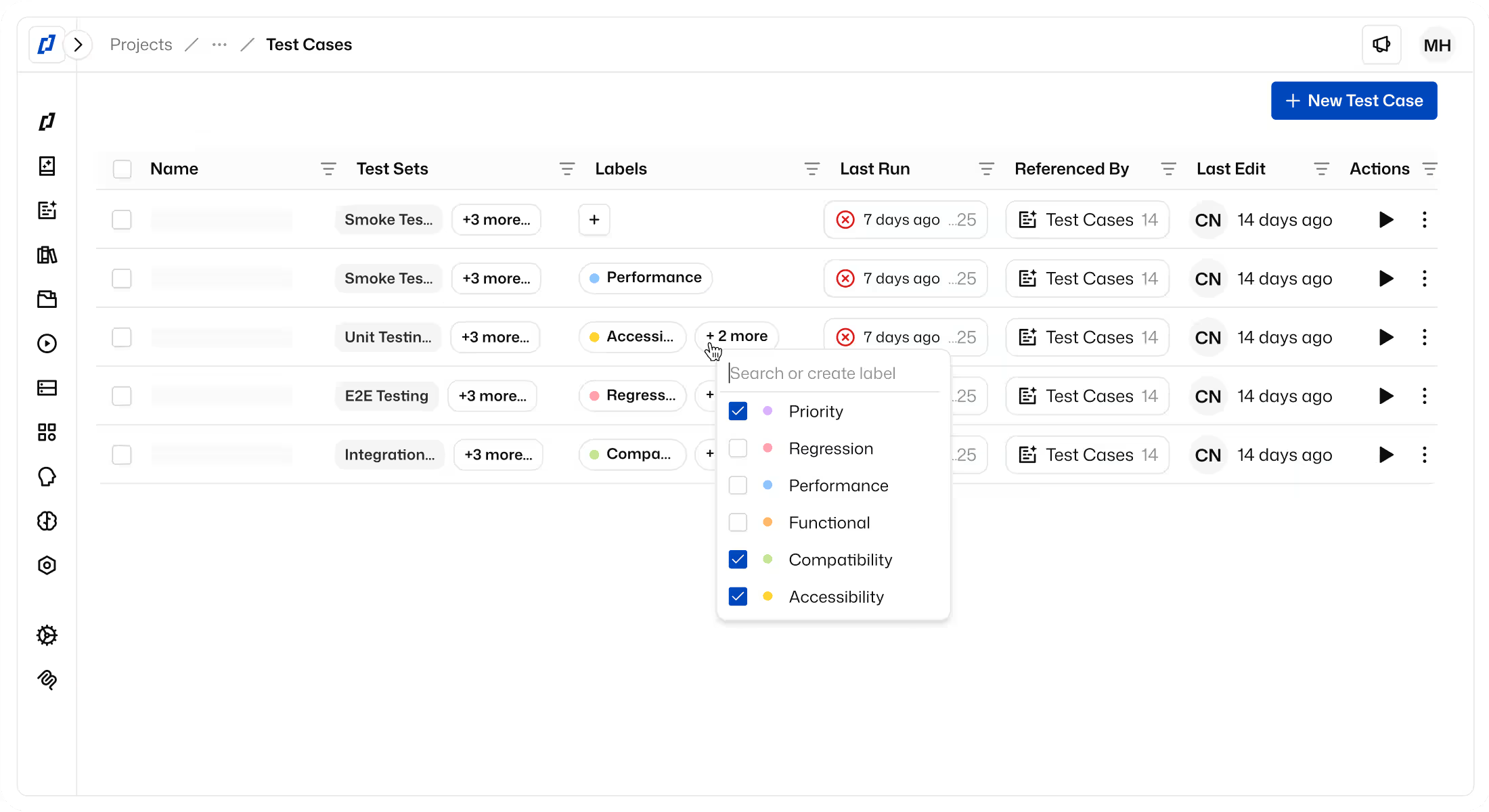
| Decides what not to test | Test sets and labels let each release run only what's at risk, and AI coaching flags fragile steps before they waste a run |
| Knows when to test | Test sets run on several clocks at once: on every deploy, on a schedule (daily, weekly), or on demand |
| Knows what "correct" looks like | Tests are generated from your specs and Jira tickets as plain-language intent, so the agent checks what the feature is for, not just that a button clicked |
| Has taste | The accessibility persona flags barriers a functional test would pass, and visual comparisons catch layout shifts nobody wrote an assertion for |
| Shows its work | Every step comes with a screenshot, every failed run explains why it broke and how to fix it, and the evidence is readable by a human in seconds |
That's the bet Thunders is built on: the leap from scripts to agents matters more than any single feature. You describe what to test in natural language. Agents write the tests, run them, and maintain them when your UI changes, across end-to-end, API and mobile flows. Every run leaves evidence a human can check in seconds.
The traits that still sound like science fiction, ten thousand simulated users, a tester with opinions about your padding, are exactly what this foundation is for. An agent that already reads intent instead of selectors gets smarter with every release it tests. A script that breaks every time someone renames a CSS class never will.
The question behind the question
So, can QA be superintelligent?
Look back at the eight traits. None of them is about clicking faster. They're about judgment: what changed, what matters, when to look, what's right, what feels right, and how sure you are. Great QA engineers have always brought that. Their problem was never intelligence. Most of their week just went to keeping scripts alive.
So maybe the better question is where your team's intelligence goes: into quality, or into upkeep.
Agents take the upkeep. Your team keeps the judgment.
Want to see how far the agents have got? Run your first test in natural language, free, or book a demo and bring the flow that breaks most often.

.png)